
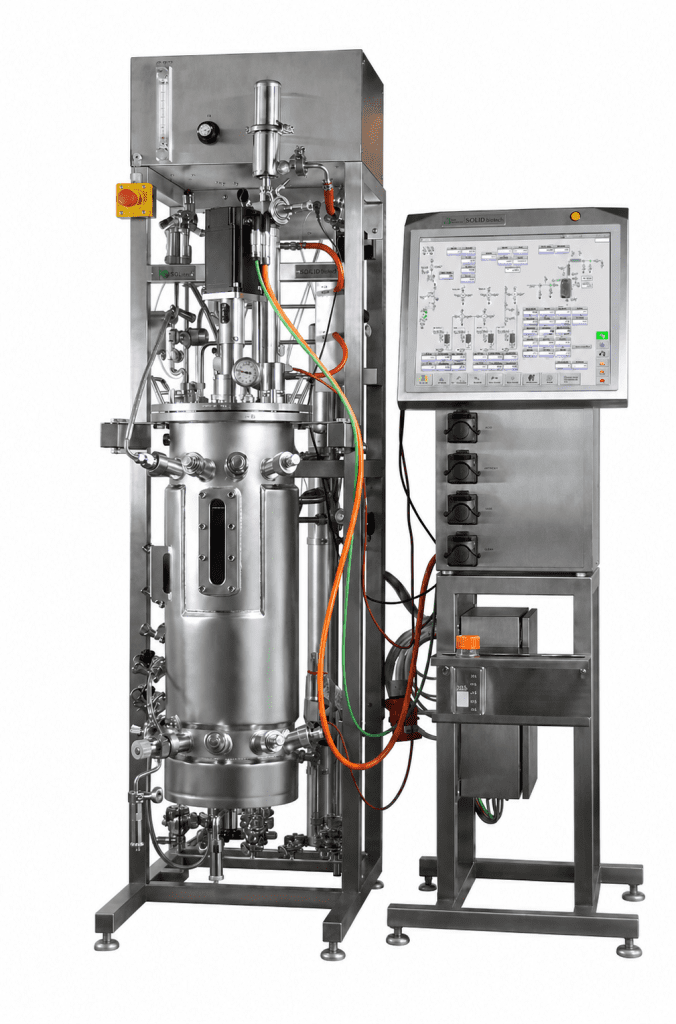
bbi-biotech pilot-scale bioreactors help transfer laboratory processes into SIP-capable stainless-steel systems for scale-up, process characterization and pre-production work – with the same xCUBIO automation logic used across the portfolio.
- Stainless steel
- Standard vessel sizes 2–50 L
- Special heights for Fermentation & Cell Culture
- Scale-up & process transfer
- CIP depending on project scope
- Sterilization via steam or integrated electric heating
Find the right xCUBIO path for your process
Not every scale-up question requires the same bioreactor concept. xCUBIO can be configured for flexible benchtop work, parallel process development, SIP-capable pilot scale, production operation or retrofit projects for existing stainless-steel systems.
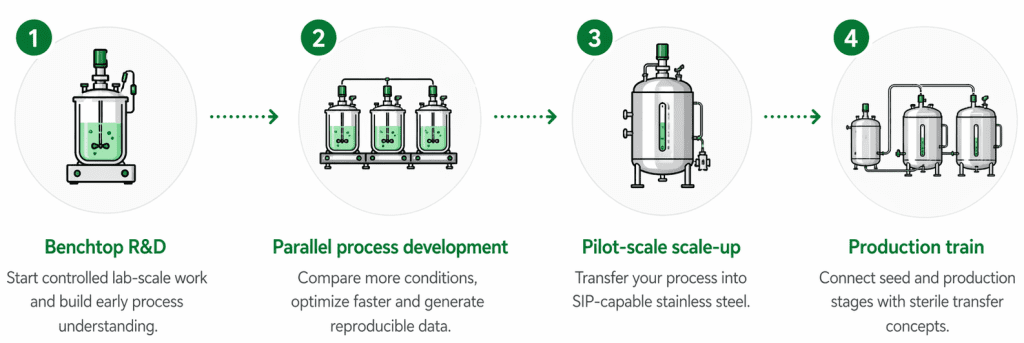
Benchtop Systems

250 ml – 10 L | Glass and other options
Parallel Systems

2–24 vessels | Modular process development
Pilot-Scale Systems

Stainless steel | SIP-capable scale-up systems
Production Systems

100 L – 10,000 L+ | Production trains
Retrofit Systems

For existing systems | Modern automation
All systems run on the same xCUBIO automation platform.
What role should your pilot bioreactor play?
A pilot-scale bioreactor can serve very different purposes. It may be a standalone stainless-steel reactor for process characterization, a seed fermenter for a larger production system, a transfer step from glass to stainless steel, or a qualification-oriented system for more defined project environments. The system role should be clarified early, because it influences vessel design, piping, automation, documentation and sterile transfer concepts.
Standalone pilot reactor

For independent SIP-capable pilot operation
Use a standalone pilot reactor for process characterization, scale-up work, pre-production batches or repeated pilot campaigns within a controlled stainless-steel vessel.
This role is relevant when the pilot system must operate independently, with dedicated xCUBIO automation, defined utilities, process piping and documentation.
Seed fermenter system
For inoculum preparation before larger scale
Use a seed fermenter system when a smaller stainless-steel reactor prepares inoculum for a larger pilot, production or process-train vessel under controlled conditions.
This role makes sterile transfer lines, SIP concepts, transfer sequences and coordinated xCUBIO automation part of the system design from the beginning.
Process transfer reactor
For moving from glass into stainless steel
Use a process transfer reactor when a process developed in glass or autoclavable benchtop vessels must be moved into stainless-steel pilot conditions.
This role focuses on transferability: vessel geometry, mixing, gas strategy, pressure behavior, sensor package and process data should fit the later scale-up path.
Qualification-focused pilot
For defined operation and project records
Use a qualification-focused pilot when documentation, defined operation, FAT/SAT support, prepared sequences and traceability are especially important.
This role is relevant when the system supports industrial, regulated or pre-production work and the documentation must support internal qualification activities.
From benchtop development to stainless-steel pilot scale
Pilot scale is the point where a laboratory process moves from flexible glass-vessel development into a more production-relevant stainless-steel environment. Steam sterilization, integrated piping, facility utilities and defined operating routines become part of the system concept.

Same xCUBIO platform logic – extended from benchtop control to in-situ stainless-steel pilot operation.
Configure the pilot system around the process
xCUBIO pilot-scale bioreactors combine SIP-capable stainless-steel engineering with the configuration depth that defines bbi-biotech systems. The result is not a fixed pilot reactor, but a process-specific platform built around vessel design, utilities, sterile process routes, instrumentation and automation.
Typical pilot systems cover 2–50 L working volume, depending on vessel geometry and project scope. Each system is configured through coordinated engineering decisions – from material, surface finish and pressure design to xCUBIO sequences, sterile transfers, documentation and qualification support.
Working volume and vessel geometry
Define the usable scale and vessel proportions.
Specify the pilot scale through working volume, vessel geometry, operating range and the role the reactor should play in the process.
The vessel is not defined by nominal volume alone, but by the height / diameter ratio and range that make the process transferable.
- Typical 2–50 L working-volume range
- Height-to-diameter ratio and geometry
- Minimum and maximum operating volumes
Vessel material and quality selection

Choose the material around medium and process risk.
Select the vessel material according to medium, corrosion risk, cleaning strategy, sterilization concept and documentation requirements.
Flexible material selection helps match the pilot reactor to demanding media or conditions, utilities and repeated operation.
- 316L, 1.4435 or 1.4571 stainless steel
- Hastelloy or special materials if required
- PTFE-coated concepts for selected cases
Surface finish and insulation
Specify cleanability, surface quality and heat behavior.
Define surface finish and insulation around process quality, cleaning needs, operator safety, heat losses and qualification expectations.
Surface and insulation decisions influence cleanability, thermal stability, documentation and day-to-day operation.
- 0.8µm or 0.4µm internal surface roughness
- Electropolished finish for product-contact surfaces
- Insulation for heat loss and safety
Pressure design and certification
Define pressure limits and certification route.
Clarify pressure design early, because it affects vessel construction, safety concept, documentation and certification.
The pressure concept must match both the process requirements and the installation region from the beginning.
- Process pressure and design pressure
- Safety concept and pressure equipment scope
- ASME, AD 2000 or local certification
Ports, nozzles and headplate layout

Plan access points for process flexibility.
Define ports, nozzles and headplate layout around sensors, additions, spargers, sampling, safety functions and future expansion.
Custom port strategy is one of the strongest ways to protect usability beyond the first defined process.
- Sensor ports, spare ports and sight glasses
- Sparger, overlay and exhaust connections
- Bottom outlet, safety valve and nozzles
Drive, seal and mixing concept

Choose the agitation architecture for the process.
Select drive position, sealing concept and mixing design around vessel layout, sterility, torque demand, serviceability and process.
The standard concept is typically a double mechanical seal, with other drive options available where suitable.
- Top-drive or bottom-drive configuration
- Double mechanical seal as typical standard
- Single seal or magnetic drive where suitable
Heating, cooling and jacket concept
Define the thermal strategy around real process load.
Plan heating and cooling around vessel size, heat load, temperature range, sterilization needs and available site utilities.
Pilot systems are typically equipped with electric heating strong enough to sterilize the vessel through the jacket.
- Electric heating through the vessel jacket
- Cooling concept matched to process load
- Temperature control for pilot operation
Steam sterilization and SIP concept

Plan steam sterilization as a system function.
Define steam sterilization for the vessel and selected sterile routes, including lines, filters, valves or sampling points where configured.
Steam supply can be configured around available utilities, including plant steam, clean steam or an external generator.
- Steam sterilization of vessel and routes
- Plant steam or clean steam connection
- Optional external steam generator
Sterile addition and feed paths

Define sterile routes into the reactor.
Plan sterile additions around media, feed, acid, base, antifoam or application-specific components required during operation.
Well-designed addition paths reduce manual workarounds and keep recurring additions within the sterile concept.
- Media, feed, acid, base and antifoam
- Headplate or side-port addition routes
- Inter-sterilizable paths where required
Inoculation and transfer paths

Connect vessels and process stages.
Define inoculation and transfer paths when the pilot reactor serves as a seed stage or connects to another vessel.
Sterile transfer design can make the pilot system part of a wider process architecture instead of an isolated vessel.
- Seed-fermenter or transfer-vessel role
- Sterilizable lines to larger vessels
- Transfer sequences and valve concepts
Sterile sampling and sample handling

Define how samples leave the sterile system.
Plan sampling around sterility, operator access, sample frequency, analytical workflow and the required level of process security.
The sampling concept affects data quality, handling effort and confidence in every sample taken during the run.
- Manual or steam-sterilizable sampling
- Sampling valve and sample route design
- Recurring samples where required
Gas, foam and exhaust strategy

Adapt aeration and exhaust to the culture.
Configure gas supply, foam handling and exhaust treatment according to organism, process mode, metabolism and gas-transfer.
Gas and exhaust strategy often determine how stable, controllable and transferable the pilot process becomes.
- Gas-mix, sparger and overlay concept
- Foam detection and antifoam logic
- Exhaust filtration, cooling and analysis
Sensors, balances and process data

Build the measurement layer for pilot decisions.
Define sensors, balances and process data around control quality, data integrity and the information needed for scale-up decisions.
Measurements turn pilot operation into process knowledge that can guide engineering and development.
- pH, DO, temperature and pressure
- Foam, level, redox and conductivity
- Load cells, balances and off-gas data
xCUBIO automation concept across all scales

Keep the platform logic across scales.
Configure xCUBIO automation to coordinate pumps, MFCs, valves, sensors, balances, external signals and recurring pilot operations.
The familiar xCUBIO platform logic is extended with the functions needed for in-situ pilot operation.
- Pumps, MFCs, valves and sensors
- Profiles, alarms and operator functions
- External signals and process integration
Prepared operating sequences

Structure recurring sterile operations.
Use prepared xCUBIO sequences to support recurring operations such as sterilization, pressure tests, transfers, inactivation or harvest.
Strong sequence concepts reduce manual variation and make repeated pilot work more consistent and convenient.
- Vessel SIP and pressure-hold tests
- Transfer-line or sampling-valve SIP
- Inactivation, transfer or harvest steps
Documentation and qualification support

Define the project record and support scope.
Specify documentation according to project requirements, internal qualification needs, traceability expectations and agreed scope.
A clear documentation package turns engineering decisions into a usable project record for technical and QA teams.
- P&IDs, wiring and component lists
- Certificates, FAT and sequence records
- IQ/OQ support depending on scope
A pilot bioreactor is not defined by vessel volume alone. The final system results from coordinated decisions about stainless-steel design, utilities, sterile process routes, instrumentation, xCUBIO automation, prepared sequences and documentation scope.
Supply frame and integrated process piping
A pilot-scale bioreactor is not defined by the vessel and controller alone. For SIP-capable stainless-steel work, the supply frame becomes a central part of the system architecture: it brings utilities, process piping, tempering, gas supply, exhaust handling and SIP preparation into one engineered concept.
Based on long experience with sterile bioprocess systems, bbi-biotech designs the supply frame around the vessel, the process and the intended operating workflow. The result is a pre-assembled, tested and installation-ready process system – not a collection of separate components.

Supply media

Bring utilities into the system in a defined way.
The supply frame integrates all utility connections for pilot operation, including compressed air, gases, cooling water, steam utilities and project-specific media.
Defined supply-media routing reduces interface uncertainty and supports cleaner installation and operation
- Supply-media and utility connections
- Pressure regulation and shut-off valves
- Filters and hygienic utility routing
Steam distribution

Route steam where sterile operation requires it.
Steam distribution is engineered for the vessel and sterile process routes, including filter housings, sampling points, addition paths or transfer lines where configured.
Steam routing is not an accessory detail; it is part of the overall engineered sterile operating concept.
- Steam distribution for SIP routes
- Plant steam or clean steam connection
- External steam generator where required
Condensate handling

Plan condensate removal as part of SIP design.
Condensate manifolds, condensers and steam traps can be integrated so steam-sterilized routes can be operated in a controlled and serviceable way.
Good condensate handling supports reliable SIP behavior and prevents sterile routes from becoming improvised pipes.
- Condensate manifolds and condensers
- Steam traps in hygienic execution
- Insulated piping where required
Cooling water

Connect cooling utilities to the thermal concept.
Cooling water or other cooling utilities can be routed through the supply frame and connected to the tempering concept according to vessel size and process heat load.
Cooling is planned as part of the process system, not as an afterthought beside the reactor system.
- Cooling-water inlet and return connections
- Cooling integration for heat removal
- Project-specific utility adaptation
Tempering system

Connect the vessel jacket to controlled thermal operation.
The supply frame can integrate the tempering system that links the vessel jacket with circulation, electric heating, cooling and heat-exchanger-based utility concepts.
Thermal control is treated as an engineered and integrated system function, not as a simple heating loop.
- Closed tempering circuit
- Integrated electric heating
- Heat-exchanger-based utility concept
Aeration group

Build aeration and gas handling into the frame.
The inlet air and gas-mix concept can be integrated with sterile filter housings, pressure regulation, bypass aeration and steam connections where required.
Aeration becomes part of the sterile system architecture, not merely an external gas connection.
- Sterile inlet-air filter housing
- Gas-mix or aeration group
- Steam connection for sterile operation
Exhaust group

Treat exhaust as a controlled sterile route.
The exhaust group includes exhaust cooling, sterile exhaust filtration, pressure sensing and pressure-control elements depending on process and project scope.
A defined exhaust path improves filter protection, pressure behavior and operational safety.
- Powerful exhaust cooler
- Stainless steel filter housing
- Pressure sensor and control options
SIP integration

Integrated SIP as part of the system architecture.
SIP integration is part of the pilot-scale system concept. The supply frame brings together the steam, condensate, sterile filters, selected valves and process routes required.
SIP is not an optional accessory around the vessel, but a core function of the integrated pilot system.
- Sterilization of vessel
- Sterilization of all routes
- Project-specific sterilization sequences
Choose the drive concept around the process – not around a fixed platform
The drive, seal and mixing concept determines how power is transferred into the vessel, how the sterile boundary is maintained and how confidently the system can be used for scale-up work.
For bbi-biotech pilot systems, a mechanical drive with double mechanical seal and condensate lubrication is the typical standard. A single mechanical seal can be specified as a more cost-conscious alternative, while magnetically coupled drives can be evaluated when requested and technically suitable.
| Decision area | Top Drive | Bottom Drive |
|---|
| Typical use | Standard choice for many pilot-scale stirred-tank systems, especially when high torque, high speed, direct mechanical logic and familiar scale-up behavior matter. | Selected when customers prefer a production-oriented layout, when the design should move closer to larger reactors, or when top-side access should remain more open. |
| Strengths | Robust and proven concept for microbial fermentation, high-cell-density work, classic scale-up studies and clear service understanding. | Closer to many larger production-reactor layouts and helpful where vessel top access, headplate space or production-style design are important. |
| Engineering focus | Balance motor position, installation height, headplate layout, impeller concept, service access and torque demand. | Balance bottom geometry, drive integration, complete drainability, service access and production-oriented process transfer. |
| bbi note | Often the natural pilot-scale choice when process performance and mechanical transparency are the priority. | Complete emptying remains possible, but requires a carefully shaped vessel bottom and more complex engineering. |

| Drive seal | Double mechanical seal | Single mechanical seal | Magnetically coupled drive |
|---|---|---|---|
| Typical use | Typical bbi-biotech standard for SIP-capable pilot systems where sterile operation, repeated runs and robust engineering matter. | Cost-conscious alternative for applications where the process risk and sterility requirements allow a simpler sealing concept. | Option for selected projects when requested and when torque, speed range, cleaning concept and process suitability fit the application. |
| Strengths | Strong sterile boundary, condensate lubrication, robust SIP integration and good suitability for demanding pilot operation. | Lower complexity, reduced seal-support effort and lower cost compared with a double mechanical seal concept. | Contactless torque transfer without a classical dynamic shaft seal at the vessel boundary. |
| Limitations | Requires seal support, condensate handling and correct integration into the utility and SIP concept. | Less robust for demanding sterile work than a double mechanical seal and less suitable as the default pilot concept. | Must be checked carefully for torque, speed range, cleaning, heat behavior and scale-up relevance. |
| bbi note | The preferred standard when sterility and long-term pilot reliability are central. | A practical alternative when budget and process risk are the leading constraints. | Technically possible, but not chosen only because it is marketed as modern. |
Impellers, baffles and spargers are process-specific and can be exchanged or removed where required. The drive concept provides the mechanical foundation; the internal setup defines gas transfer, shear, solids handling, foam behavior and cleaning access. The right drive concept is selected during pre-engineering. bbi-biotech does not force the process into a fixed platform; the mechanical concept is chosen around sterility, torque demand, serviceability, vessel layout and scale-up relevance.
Heating, cooling and SIP as one engineered concept
Pilot-scale xCUBIO systems are engineered with a closed tempering concept for controlled cultivation, active cooling and in-situ sterilization. The vessel jacket, circulation loop, heat exchanger, electric heating, cooling supply and SIP routes are planned as one system around the process and available utilities.
Closed tempering circuit

Keep thermal control inside a defined loop.
The vessel jacket is connected to a closed circulation loop that supports controlled heating, cooling and temperature profiles for sterilization.
This creates a stable thermal concept for pilot work, instead of relying on direct utility flow through the vessel jacket.
- Closed loop for jacket temperature control
- Circulation pump and controlled flow path
- Defined fill, drain and safety concept
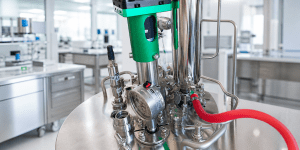
Indirect heat transfer
Separate process control from utility media.
Heat and cooling energy can be transferred through a heat exchanger, keeping the tempering circuit functionally separated from utility media.
This is the decisive engineering difference: the jacket loop is controlled indirectly, not simply heated or cooled as an open line.
- Heat exchanger between utility and loop
- Indirect heating and cooling transfer
- Clear separation from utility supply
Electric heating concept

Use electric heating as the typical pilot basis.
Pilot systems are typically equipped with an electric heating concept strong enough to sterilize the vessel through the jacket.
This allows many pilot projects to operate without plant steam as a mandatory starting requirement.
- Strong electric heating as typical concept
- Vessel sterilization through the jacket
- Reduced dependency on plant steam
Optional steam supply

Add steam utilities where needed.
Plant steam, clean steam or an external steam generator can be integrated when the site concept or sterilization scope requires it.
Steam is therefore a configurable utility option, not the only way to build a SIP-capable pilot system.
- Plant steam where available
- Clean steam where required
- External steam generator option
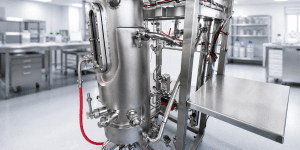
Cooling and heat removal
Plan cooling around real process load.
Cooling is configured according to vessel size, heat generation, temperature range, cultivation strategy and available site utilities.
The cooling concept must match the biological process and growth, not only the nominal vessel volume.
- Cooling water or external chiller
- Heat removal through the thermal loop
- Temperature control during cultivation
SIP means more than a vessel

Sterilize all sterile paths.
SIP includes the vessel and selected sterile routes such as inlet air, exhaust, sampling and addition paths where configured.
SIP is an independent engineering scope and should not be confused with a full CIP promise.
- Inlet air and exhaust filter housings
- Sampling valve and sample route
- Sterile addition paths where configured
The heating, cooling and SIP concept defines how the pilot bioreactor behaves as an in-situ stainless-steel system. It connects jacket control, indirect heat transfer, electric heating, optional steam utilities, cooling and sterile routes into one engineered process concept.

Application fit: Configure xCUBIO around the process
xCUBIO pilot bioreactors can be configured for standard microbial and cell-culture workflows, but also for more demanding or less conventional applications.

Microbial cultivation
For aerobic bacterial processes, fed-batch strategies, DO control, pH correction, foam handling and defined gas supply.

Mammalian cell cultivation
For controlled cell-culture workflows with CO₂, gentle mixing, optical DO, dissolved CO₂, glucose and viable-cell-density options.

Insect cell cultivation
For cell-culture-style processes with adapted mixing, gas control, temperature strategy and monitoring requirements.

Anaerobic cultivation
For anaerobic workflows requiring oxygen exclusion, N₂-based gas strategies, redox monitoring or defined low-oxygen conditions.

Fungal
cultivation
For fungal processes where morphology, viscosity, pellet formation or mycelial growth influence mixing and vessel geometry.

Phototrophic cultivation
For phototrophic experiments or algae-related workflows where light and vessel concept need to be considered together.

Carrier-based cultivation
For applications involving surfaces, carriers or attachment-based growth where geometry and sampling needs adaptation.

Perfusion-like cultivation
For continuous additions, balance-supported feeding, harvest/bleed concepts and sequence-controlled liquid handling.

High-cell-density cultivation
For processes with high oxygen demand, strong feeding requirements, foam risk, heat load or increased monitoring needs.

Pichia
cultivation
For methanol-related workflows, high oxygen demand, feeding strategies, foam control and off-gas-based process insight.

Substrate-based cultivation
For workflows where methanol, glucose or other substrates should be monitored or controlled as part of the process strategy.

Off-gas-driven cultivation
For applications where O₂, CO₂, OUR, CER or RQ help interpret metabolism, feeding, induction or process transitions.

High-solid
cultivation
For applications that do not behave like standard stirred liquid cultures and may require adapted vessels, impellers or outlets.

Komagataella cultivation
For methanol-related workflows, high oxygen demand, feeding strategies, foam control and off-gas-based process insight.

Academic R&D and training
For universities and research groups that need real bioreactor functionality, flexible setups and expandable configurations.
xCUBIO pilot systems can be configured for standard microbial and cell-culture workflows, but also for more demanding or less conventional applications. The relevant setup depends on the organism, vessel concept, gas strategy, feeding approach, sensor package, sampling needs and automation depth.
Automation & Control with xCUBIO – one consistent automation platform across all reactor types and scales
xCUBIO brings structured operation, advanced process logic and flexible integration into one coherent automation environment across bbi-biotech bioreactor systems.
From benchtop and parallel glass systems to SIP-capable stainless-steel pilot and production bioreactors, users work with one consistent automation philosophy instead of fragmented controller generations.
The result is a shared control logic for process development, scale-up, production and retrofit projects – supporting familiar operation, scalable process logic and flexible integration across reactor types and vessel concepts.


One platform across systems and scales
xCUBIO provides one consistent automation platform across different bioreactor types, process concepts and development stages.
Instead of forcing users to adapt to different controller logics as systems grow more complex, it creates a shared operating structure that supports comparability, faster familiarization, cleaner transfer of process logic and a more coherent path from early development to larger-scale operation.

Premium automation beyond conventional controller logic
A serious bioreactor controller must provide clear overview screens, reliable control loops and direct manual access where needed. xCUBIO does all of that as a matter of course – but its real strength lies far beyond conventional controller logic.
The platform combines real-time process visualization, integrated alarm handling, manual actuator access, profile functions, advanced sequences, data recording and export within one structured operating environment designed for significantly greater depth, flexibility and process control than a conventional controller typically offers.

Profiles, Sequence Editor & Valve Editor
This is where xCUBIO becomes especially powerful. Time-dependent profiles allow process values and actuator outputs to follow defined progressions instead of remaining static.
The graphical Sequence Editor and Valve Editor enable users to automate recurring process steps and genuinely process-driven routines without conventional programming including complex valve-position logic and valve state changes.
Together, these tools bring an unusual level of automation freedom to the user: powerful process logic without the need to build custom software for every advanced routine.

Built for flexible process architecture and connectivity
xCUBIO is designed for processes that do not fit into rigid standard architectures. Additional sensor technology, external devices and analytical signals can be integrated with exceptional flexibility, while pumps and other functions can be assigned in ways that reflect the real needs of the process rather than a predefined package logic.
At the same time, trend recording, CSV export, remote access via integrated VNC functionality and OPC connectivity support structured data use, system integration and future-ready automation concepts.

Automation
Sequence Editor
Valve Editor
Complex Recipes

Flexibility
Sensor Choice
Gasmix Configs
Control Possibilities

Visualization
19″ Touch-Screen
Trend-Displays
Live Visualization

Connectivity
Remote Access
OPC Interfaces
Export Features

Tell us about your bioreactor project
Whether you are planning a new bioreactor, comparing vessel concepts, scaling up a process or looking for support for an existing system, we will route your enquiry to the right team and next step.

I want to discuss my application
For early project discussions, process requirements, vessel selection, automation options, scale-up paths and technical feasibility questions.
I need a bioreactor quote
For defined system requests, planned purchases, quotation preparation or projects where required options are already reasonably clear.
I need service or spare parts
For running systems, service cases, complete vessel and spare parts needs, or selected upgrade or hardware requests and questions.
Direct contact to Berlin head office
+49 (0)30 221 800 10
info@bbi-biotech.com
bbi-biotech GmbH
Landsberger Str. 259
12623 Berlin