
Production-scale stainless-steel bioreactors from approx. 100 L to 10,000 L+ working volume – engineered as single production vessels, seed-to-main fermentation lines or complete sterile bioprocess systems.
- 100 L–10,000 L+ working volume
- Single vessels or complete production trains
- Dedicated xCUBIO controller per vessel
- Sterile seed-to-main transfer concepts
- SIP/CIP-capable vessels, lines and filters
- Documentation and qualification support

bbi-biotech designs and supplies custom production bioreactors and stainless-steel process systems with dedicated xCUBIO automation per vessel, SIP/CIP-capable vessel and line concepts, sterile transfer paths, project-specific valve automation and documentation support depending on project scope.
What kind of production project are you planning?
Production-scale projects can start with a single stainless-steel bioreactor or require a complete sterile process system. bbi-biotech helps define the right scope around your process, available utilities, transfer strategy, automation requirements and documentation needs.
Single production bioreactor

A dedicated production vessel with its own xCUBIO controller and automation, defined SIP/CIP concepts and clear process interfaces.
Seed + main fermenter

A smaller seed fermenter connected to a larger production vessel with sterile transfer logic, transfer-line SIP and coordinated operation.
Complete production train
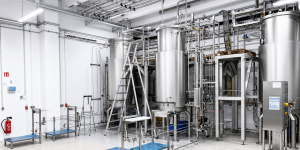
Seed vessel, main reactor, media/feed/additive vessels, transfer lines, SIP/CIP paths, valve automation and documentation.
Custom stainless-steel process system

A project-specific sterile process system around the bioreactor, including process piping, supply frames, filters, utility interfaces and automation.
Pre-engineering for production systems

For larger production projects where P&ID, layout, vessel, utilities, transfer paths, valve automation and documents are defined pre-quotation.
Production bioreactor or complete production train?
At production scale, the bioreactor is often only the core of the system. The complete process may also include seed vessels, sterile transfer lines, media or feed vessels, additive vessels, CIP/SIP paths, valve automation, process piping and documentation packages. bbi-biotech can configure the project scope from a single production vessel to a complete stainless-steel production train.
| Project scope | Typical situation | Engineering focus |
|---|---|---|
| Single production bioreactor | One production vessel is required with defined interfaces to customer utilities or existing equipment | Vessel design, automation, SIP/CIP, gas supply, exhaust, documentation |
| Seed-to-production train | A smaller seed fermenter feeds a larger main production vessel | Sterile transfer, controller communication, transfer-line SIP, flexible transfer modes |
| Complete production train | Multiple vessels and process paths must be planned as one system | Reactions vessels, feed/additive vessels, transfer paths, CIP/SIP, valve automation, FAT/SAT and documentation |
| Integrated process system | The vessel is part of a larger sterile production environment | Utility integration, process piping, filters, valves, external interfaces and qualification-oriented documentation |
Dedicated xCUBIO controller per vessel
In production-oriented xCUBIO systems, each vessel has its own dedicated controller and HMI. This keeps vessel-level operation, process control and responsibility clear. A seed fermenter and a main production fermenter can be operated independently, while controllers exchange variables and coordinate defined workflow steps where the process requires it.
- Independent vessel operation
- Dedicated 19″ HMI per vessel
- Variable exchange between controllers where required
- Coordinated sequences for transfer, cleaning or sterilization
- Clear responsibility at vessel level
- Scalable architecture for seed-to-production trains
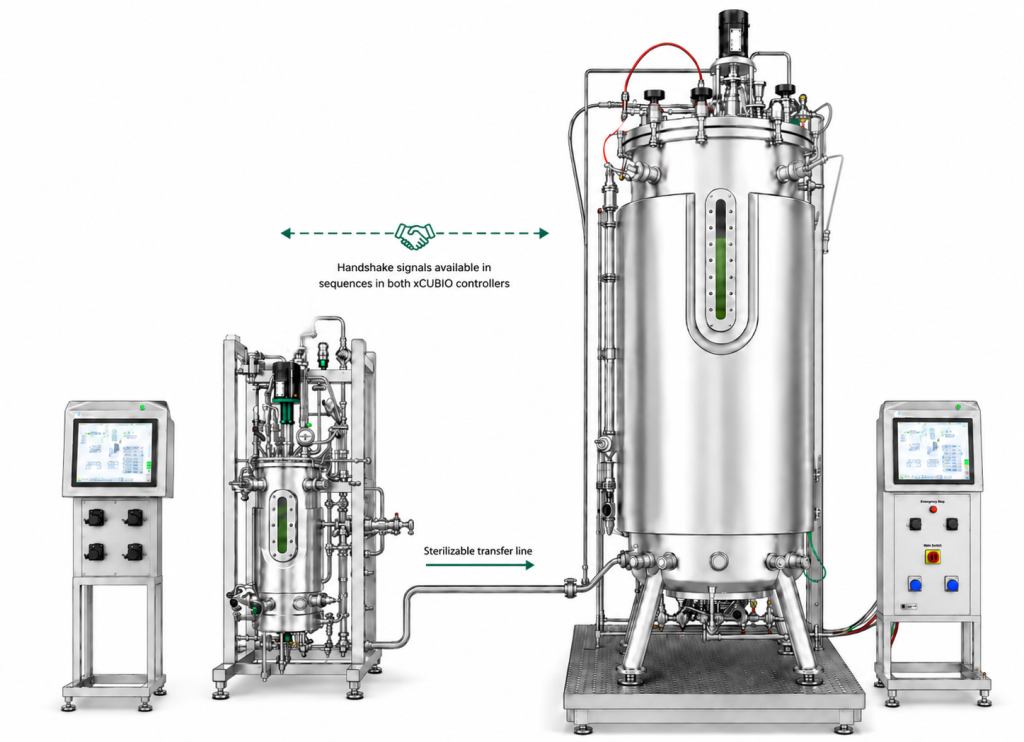
This architecture is especially useful for production trains with sterile transfer steps, shared process information, interlocks or handshake signals between vessels.


Engineer the production system around the process
Working volume is only the starting point – the real system design is defined by the biology, the production strategy and the sterile process paths around the vessel.
A production-scale bioreactor should therefore be defined from the process backwards. The vessel size matters, but it does not determine the system alone. A high-cell-density microbial process, a sensitive cell-culture application, a seed-to-main production train or a sterile ingredient process can lead to very different decisions for agitation, oxygen transfer, heat removal, SIP/CIP, transfer logic, sensors, automation and documentation.
| Engineering area | Key decisions |
|---|---|
| Vessel concept | Working volume, total volume, pressure concept, vessel geometry, material, surface finish and production capacity |
| Biology and process mode | Organism or cell type, batch or fed-batch strategy, growth behaviour, oxygen demand, heat generation, foam tendency and main-reactor occupancy time |
| Seed and transfer strategy | Seed ratio, inoculation concept, seed-to-main transfer, media transfer, harvest path, pump or pressure transfer and transfer-line SIP |
| Utilities and supply frame | Plant steam or clean steam, cooling water, compressed air, gas supply, condensate handling, exhaust interfaces and available site utilities |
| Heating, cooling and SIP | Jacket and heat-exchanger concept, temperature-control strategy, vessel SIP, line SIP, filter SIP and sterilization of relevant process path |
| CIP as part of the process design | Cleanability, drainability, spray devices, CIP circulation, conductivity control, rinse-end detection, valve layout and cleaning of transfer paths |
| Gas, pressure, foam and exhaust | Air, O₂, N₂, CO₂ or custom gases, MFC concept, pressure measurement and control, foam handling, exhaust cooling, exhaust filtration and off-gas analytics |
| Sensors, PAT and data use | pH, DO, temperature, pressure, foam, conductivity, off-gas, balances, external analytics, data recording, control loops and sequence use |
| Automation and valve logic | Vessel-level controllers, sequence logic, valve states and controller handshakes for defined production steps |
| Documentation and qualification | P&ID, material certificates, pressure vessel documentation, weld and surface documentation, FAT/SAT, IQ/OQ support, CE/PED, AD2000 or ASME alignment |


This is why bbi-biotech treats production projects as process-engineering tasks. The bioreactor, supply frame, transfer paths, utilities, valve automation and xCUBIO control architecture are planned together, so that the system supports the intended production workflow instead of only matching a nominal vessel volume.
Supply frame, utilities and process piping integration
Production systems are engineered around the process, but also around the available utilities and the way these utilities must be integrated into a complete sterile process system.
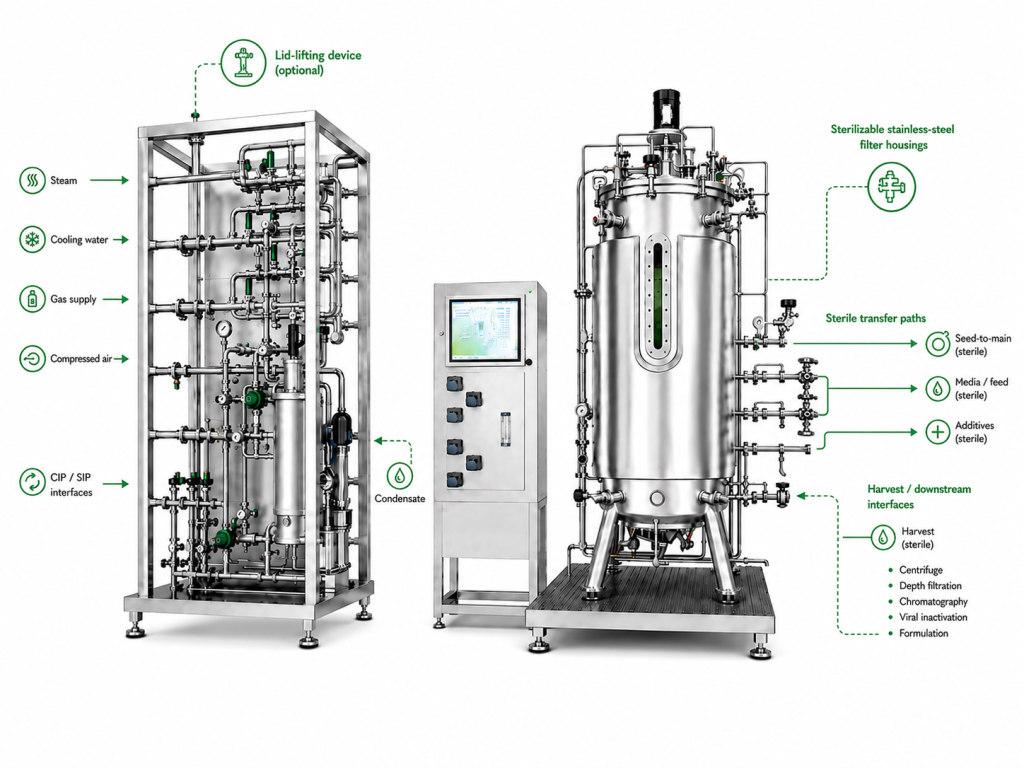
At production scale, the supply frame and process piping are not secondary accessories. They determine how steam reaches the vessel, how condensate is removed, how gases are supplied, how exhaust is treated, how sterile filters are integrated and how material moves through the system.
bbi-biotech designs and builds complete supply frames for production bioreactor systems. The supply frame, utility connections, sterile filter housings, process piping, valve groups and transfer interfaces are adapted to the customer’s available utilities, process requirements and production strategy.
This integration is especially important for sterile production workflows. Seed-to-main transfer, media addition, feed supply, exhaust filtration, harvest and defined downstream interfaces must be planned together with SIP/CIP paths, valve states, sensor signals and automation logic. Where required, these functions can be represented in the P&ID and integrated into xCUBIO sequences for defined, repeatable operation.

Production vessel design, materials and surface finish
The production vessel is specified around the process, not only around nominal volume. Working volume, headspace, vessel geometry, steam sterilization, materials, surface finish and standards alignment are engineered together to create a long-term production-grade bioprocess asset.
Working volume and total volume

Process capacity
Working volume defines the usable process range, but total volume, headspace and filling level determine how the vessel behaves in real production. Foam formation, gas exchange, feed strategy and sterilization requirements can all influence the final vessel size.
A well-defined volume concept supports realistic batch planning and avoids vessels that look correct on paper but create operational limitations.
- Working volume and total volume defined together
- Headspace considered for foam and gas exchange
- Filling level aligned with process and SIP strategy
Freely engineered vessel geometry
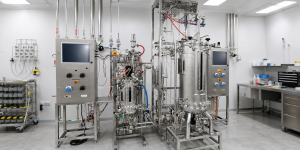
Process-driven shape
The vessel geometry is engineered around the process rather than selected from a fixed tank catalogue. Height-to-diameter ratios from approx. 1:1 to 4:1 can be engineered depending on process, mixing, oxygen transfer, footprint and headspace requirements.
This flexibility helps match the vessel shape to production capacity, mixing behaviour, available floor space and future scale-up logic.
- Height-to-diameter ratio from approx. 1:1 to 4:1
- Geometry selected around mixing and oxygen transfer
- Footprint and headspace considered from the start
Steam-sterilizable vessel design

Sterile production readiness
bbi-biotech production vessels are designed for steam sterilization. Vessel body, ports, fittings and process connections are considered together with the SIP concept, so the vessel can become part of a defined sterile production workflow.
Steam sterilization is not an add-on. It influences vessel layout, instrumentation, valves and sterile process paths from the beginning.
- Steam-sterilizable production-vessel concept
- Ports and fittings considered with SIP logic
- Vessel design aligned with sterile operation
Stainless-steel material concept
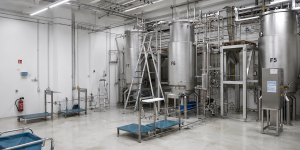
Standard production materials
Standard production vessels are typically built from stainless steels such as 1.4404 and 1.4435 / 316L. These materials are widely used for sterile bioprocess equipment and provide a robust basis for reliable, scalable long-term production operation.
Material selection reflects process media, cleaning strategy, sterilization conditions, documentation requirements and expected service life.
- 1.4404 and 1.4435 / 316L as standard options
- Material choice aligned with process media
- Suitable basis for sterile production equipment
Special materials and coated concepts

Demanding media
For demanding processes, special material concepts can be evaluated project-specifically. Options can include 1.4571 / 316Ti-related stainless steel, Hastelloy, other special alloys or PTFE-coated concepts where metal contact must be reduced or avoided.
This is especially relevant for aggressive media, seawater-related applications, unusual cleaning regimes or specific material-compatibility requirements.
- 1.4571 / 316Ti-related stainless option
- Hastelloy, special alloys or PTFE-coated concepts
- Suitable for demanding or seawater-related processes
Product-contact surface finish
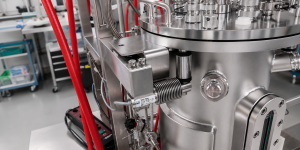
Cleanability and hygiene
Internal product-contact surfaces are specified with defined roughness requirements. Ra ≤ 0.8 µm is the typical standard, while Ra ≤ 0.4 µm or better can be specified where the process, cleaning strategy or qualification expectations require it.
Internal product-contact surfaces are electropolished as part of the standard production-vessel concept for improved cleanability and hygienic performance.
- Ra ≤ 0.8 µm as typical internal standard
- Ra ≤ 0.4 µm or better where required
- Electropolished internal product-contact surfaces
Long-term robust vessel construction

Production-grade durability
A production vessel must remain serviceable, cleanable and reliable over many production cycles. Vessel wall design, support structure, access, nozzles, bottom geometry, drainability and external finish are considered as part of the long-term production concept.
The goal is not only to meet today’s specification, but to build a vessel that remains practical for operation, maintenance and future process needs.
- Drainability considered in vessel geometry
- Access and nozzles planned for real operation
- Robust construction for long-term production use
Standards and market alignment

Destination-market readiness
Production-vessel requirements depend on pressure rating, destination market, project scope and qualification needs. bbi-biotech can align vessel design and documentation with CE/PED, AD2000, ASME and Chinese or Korean market expectations.
Standards alignment should be discussed early, because pressure vessel design, manufacturing route, documentation and acceptance strategy are connected.
- CE/PED, AD2000 and ASME depending on scope
- Chinese and Korean pressure certificates
- Aligned documentation strategy
The result is a production vessel that is not defined by volume alone. Geometry, headspace, steam sterilization, material selection, surface finish, drainability, documentation and market requirements are engineered together so the vessel supports the intended production process throughout its lifecycle.
Port layout, nozzles and access strategy
The port concept can start from proven standard arrangements and is then adapted to the process, vessel size, sterility requirements and future expansion needs.
Sensor ports
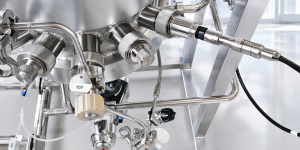
Core measurement access
Standard sensor positions support core process values such as pH, DO, temperature, pressure, foam or level. Additional probes can be added where deeper monitoring, redundancy or improved service access is required.
Typical choices
- Ingold-style straight or angled ports
- Core probes and optional analytics
- Service access considered from the start
Additions and feed
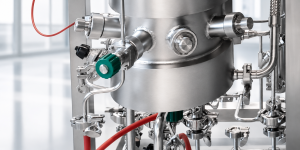
Controlled liquid entry
Feed, acid, alkali, antifoam, media or process-specific additions need defined entry points into the vessel. The standard concept can be extended for several feeds, sterile additions or dedicated dosing paths.
Typical choices
- Ingold-style ports for sensors and additions
- Dedicated feed and correction lines
- Sterile additions where required
Sampling access

Routine process insight
Sampling access should be practical, sterile and repeatable without making routine batches difficult to handle. Proven sampling concepts can be selected around vessel size, contamination risk and operator workflow.
Typical choices
- Straight Ingold-style sampling ports
- Manual aerosol-free sampling valves
- Automated sampling where required
Port and connection types

Proven bioreactor formats
Proven port formats make the vessel easier to specify, operate and maintain. Connection types are selected around function, vessel size, sterilization concept and compatibility with customer-side equipment.
Typical choices
- Ingold-style straight or angled ports
- Tri-Clamp connections where suitable
- Rd28 × 1/8″ standard headplate ports
Exhaust and filter access

Sterile gas inlet and exit
Exhaust access must match aeration rate, foam behaviour, condensate load and sterile boundary requirements. The concept can include filter housings, condensers, foam detection or off-gas analytics.
Typical choices
- Sterilizable stainless-steel filter housings
- Exhaust cooling or condenser options
- Off-gas analytics where configured
Transfer and harvest
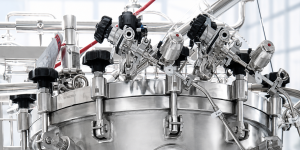
Defined process movement
Transfer and harvest ports define how seed culture, media, product or process liquid enters and leaves the vessel. Their position must support sterile transfer, emptying, cleaning and production workflow.
Typical choices
- Bottom drain / harvest connection
- Side transfer ports where useful
- Pump or pressure transfer concepts
Safety and pressure

Protected operation
Safety interfaces are planned around pressure rating, sterilization concept and operating conditions. They provide connection points for pressure protection, monitoring and safety equipment.
Typical choices
- Safety valve connection with floor-directed discharge
- Rupture disc where required or opted for
- Pressure measurement and protection
Service access and spares

Long-term usability
Service access keeps the vessel practical over production cycles. Access openings and lid handling help operators inspect, maintain, clean and adapt the system when requirements change.
Typical choices
- Spare ports for future process expansion needs
- Lid lifting or service access handling concepts
- Maintenance and operator access
A good port layout gives the process room to work. It combines proven standard arrangements with project-specific adaptation, so the vessel remains practical, sterile, serviceable and expandable throughout its lifecycle.

500l bbi-biotech bioreactor with advanced xCUBIO automation

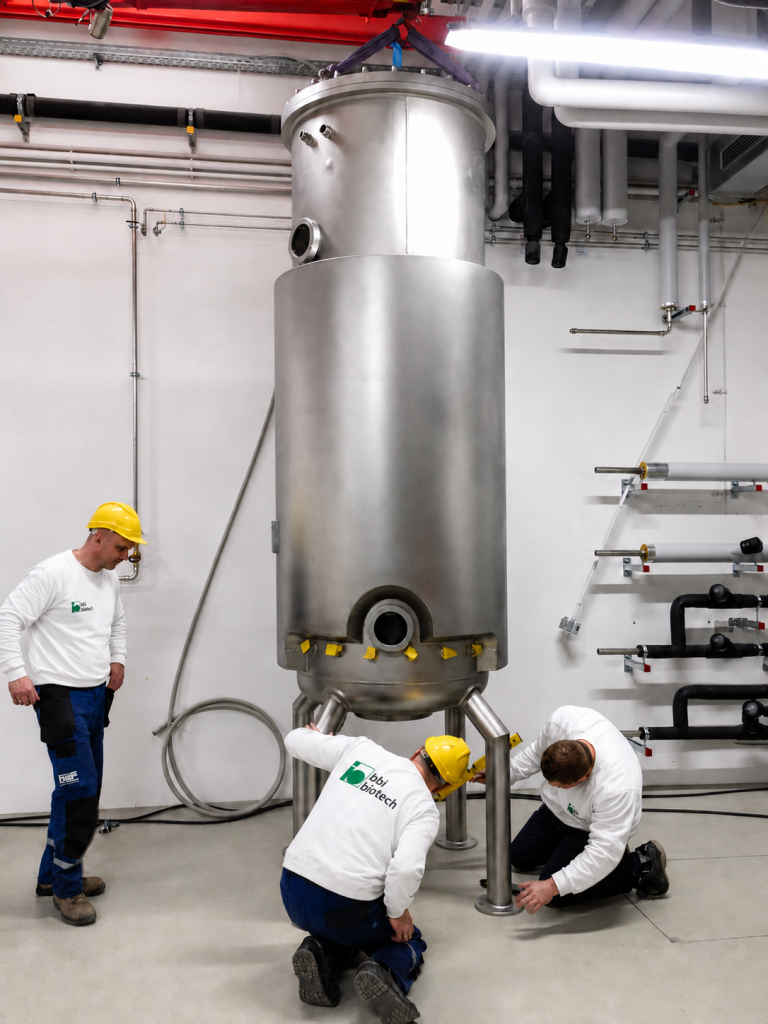
7000 L bioreactor by bbi-biotech with automation touchscreens on 2 floors
Drive, seal and agitation concept
The drive and seal concept defines how mechanical power enters the production vessel and how the sterile boundary is maintained. It must support torque demand, speed range, SIP integration, serviceability, long-term production reliability and the required agitation strategy.
Mechanical drive concept

Power transfer into the vessel
The drive concept is selected around vessel size, process viscosity, torque demand, speed range and production reliability. It provides the mechanical basis for controlled agitation and must fit the vessel layout, service concept and sterilization strategy.
The drive should not be chosen as a fixed platform feature. It should be engineered around the real mechanical and sterile production requirements.
- Torque demand and speed range
- Vessel layout and service access
- Agitation strategy and SIP concept
Double mechanical seal
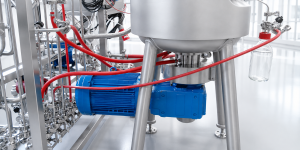
Robust sterile boundary
For SIP-capable production systems, a double mechanical seal with condensate lubrication is a strong standard concept. It supports sterile operation, repeated production runs and reliable integration into utility and sterilization workflows.
The seal concept must be planned together with SIP, condensate handling and service access because it is part of the sterile production boundary.
- Double mechanical seal concept
- Condensate lubrication integration
- Strong sterile boundary for sterilization
Single mechanical seal

Reduced complexity option
A single mechanical seal can be specified where process risk, sterility requirements and operating conditions allow a simpler sealing concept. It can reduce complexity and cost, but is not the default choice for demanding sterile production.
This option is useful when the process allows it, but it should be selected consciously rather than treated as an equivalent sterile-production standard.
- Reduced seal-support system complexity
- Cost-conscious sealing concept for media vessels
- Suitable where process risk allows
Magnetically coupled drive

Project-specific evaluation
A magnetically coupled drive can be evaluated when requested and technically suitable. However, torque range, speed range, heat behaviour, cleaning concept, SIP compatibility and scale-up relevance must be checked carefully.
Magnetic coupling is technically possible, but it should not be selected only because it sounds modern. The process must justify the concept.
- Contactless magnetic torque transfer
- No dynamic or mechanical shaft seal required
- Suitability checked project-specifically
The right mechanical concept is selected during pre-engineering. bbi-biotech does not force the process into a fixed drive platform; the drive and seal setup is chosen around sterility, torque demand, serviceability, vessel layout and production relevance.
Heating, cooling and SIP concept
Heating, cooling and sterilization are connected engineering decisions. Plant steam, clean steam, cooling-water qualities, condensate handling, heat exchangers and SIP routes are integrated around the process, the sterile boundary and the customer’s utility concept.
Steam quality and heating

Function-specific steam use
Steam quality is selected around its function in the system. Plant steam can be used indirectly through heat exchangers for temperature control or sterilization duties, while clean steam can be integrated for sterile or product-contact SIP requirements.
bbi-biotech can integrate customer-side clean steam or project-specific clean-steam generation where the process and utility concept require it.
- Plant steam through heat exchangers
- Customer-side clean-steam integration
- Project-specific clean-steam generation
Cooling quality and removal

Process heat removal
Cooling is defined around biological heat generation, vessel size, temperature range, growth behaviour and production strategy. Different cooling-water qualities or cooling circuits can be integrated where process load, temperature level or site utilities require it.
Cooling capacity should be engineered around the real process load, not only around vessel volume or generic utility assumptions.
- Cooling water or chilled water
- Glycol loop where required
- Site-specific cooling circuits
Condensate handling and recovery
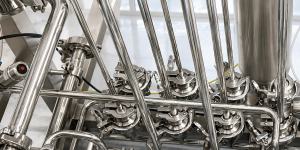
Return or discharge
Condensate handling is part of the thermal and sterilization concept. Condensate can be returned or discharged depending on steam quality, site utility concept, process boundary and the overall scope of the production system.
A defined condensate concept improves utility integration, supports safe SIP operation and prevents unclear drain or return paths later.
- Condensate return where suitable
- Condensate discharge where required
- Drain paths matched to utilities
Vessel SIP and sterilization

Reactor sterile boundary
Vessel SIP is planned around geometry, steam quality, steam flow, condensate removal, pressure rating and sterile boundaries. The reactor, valves, instruments and piping must work together as one defined sterilization concept.
SIP is more than heating the vessel. Steam distribution, hold phase, pressure monitoring and condensate removal must be engineered together.
- Steam flow and distribution
- Hold phase and pressure monitoring
- Condensate removal from vessel
Path SIP and filter housings
Sterile route protection
SIP can include more than the reactor itself. Inlet air, exhaust filter housings, sampling valves, addition lines and transfer paths can be integrated into the sterilization concept depending on process scope and sterile boundary.
Sterilizable stainless-steel filter housings can also be prepared for WIT testing where filter integrity verification is required.
- Inlet and exhaust filter SIP
- WIT-ready sterile filter housings
- Sampling, addition and transfer-line SIP
xCUBIO SIP sequence control

Repeatable operator guidance
Where required, xCUBIO sequences can support SIP workflows with valve states, heating phases, hold times, cooling steps and readiness checks. The automation should reflect the real sterilization, utility and condensate concept.
Prepared SIP workflows help operators run recurring sterilization steps in a defined, repeatable and easier-to-follow way.
- Defined SIP sequence steps
- Valve states and interlocks
- Temperature and pressure monitoring
Utility quality is part of the engineering concept. bbi-biotech can integrate plant steam, clean steam, condensate return or discharge and different cooling-water qualities in one production system where the process and site utilities require it.
CIP concept for vessels and process paths
CIP is not added at the end of a production bioreactor project. Cleaning strategy, vessel design, spray devices, transfer paths, valves, utilities, sensors and automation should be planned together from the beginning.
Integrated CIP concept

Cleaning built into the system
An integrated CIP concept can use the vessel, piping, sprayballs, drain valves, CIP pump, concentrate dosing and xCUBIO automation as one coordinated cleaning setup. The exact cleaning scope is defined around the process, vessel size and required flow paths.
Typical scope
- Vessel cleaning with sprayballs
- CIP pump and concentrate dosing
- Conductivity-based rinse verification
External CIP integration
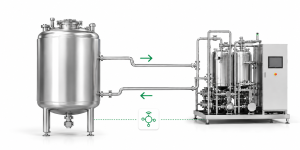
Connection to site systems
Where a customer uses central or external CIP equipment, the bioreactor can be prepared for integration with that infrastructure. Interfaces, valve logic, process paths and communication signals can be defined according to the site concept.
Typical scope
- External CIP unit interfaces
- Valve and route coordination logic concept
- OPC UA communication where configured
CIP paths and hardware

Defined cleaning boundaries
CIP scope is defined project-specifically: vessel, sprayballs, transfer lines, addition paths, exhaust-related parts or external CIP interfaces where required. The goal is a clear, practical and cleanable process boundary for operation.
Typical scope
- Sprayballs and CIP lances
- Transfer and addition path cleaning
- Exhaust-related cleaning scope definition
xCUBIO CIP automation
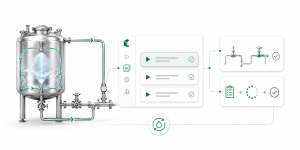
Sequences for cleaning
xCUBIO can reliably support CIP workflows with prepared sequences, configurable parameters, stored valve states and operator guidance. Mobile CIP trolleys or project-specific CIP units can be integrated where they fit the overall cleaning strategy.
Typical scope
- Valve states for cleaning paths
- Prepared CIP-related sequences
- Mobile CIP concepts where useful
The right CIP concept depends on the production system. bbi-biotech can engineer integrated CIP concepts or external CIP integration around the vessel, process paths, utilities, communication interfaces and automation strategy.
Seed-to-main transfer and sterile production paths
A seed-to-main concept allows the main production bioreactor to start with an active, pre-grown culture instead of a very small inoculum. Cells or microorganisms are first expanded in a smaller seed fermenter until the required cell density, activity or process phase is reached. The culture is then transferred into the main production vessel through a sterilizable transfer path.
This can reduce main-reactor occupancy time, support reproducible batch starts and make production scheduling more predictable. The transfer itself must therefore be treated as part of the sterile production process, not as a simple connection between two vessels.
| Planning question | Why it matters |
|---|---|
| What seed volume is required? | Defines the inoculation strategy and the scale relation between seed and main vessel |
| When should transfer take place? | Depends on cell density, activity, growth phase or process target |
| How should transfer be performed? | Pump or pressure transfer must match the process, transfer volume and vessel design |
| How is sterility maintained? | Transfer-line SIP, valves and sterile connections must be planned as one production path |
| How is the workflow coordinated? | Handshake signals and xCUBIO sequences can support defined transfer operation |
| How is the line cleaned afterwards? | Cleaning or CIP concept depends on transfer path, valve layout and process requirements |
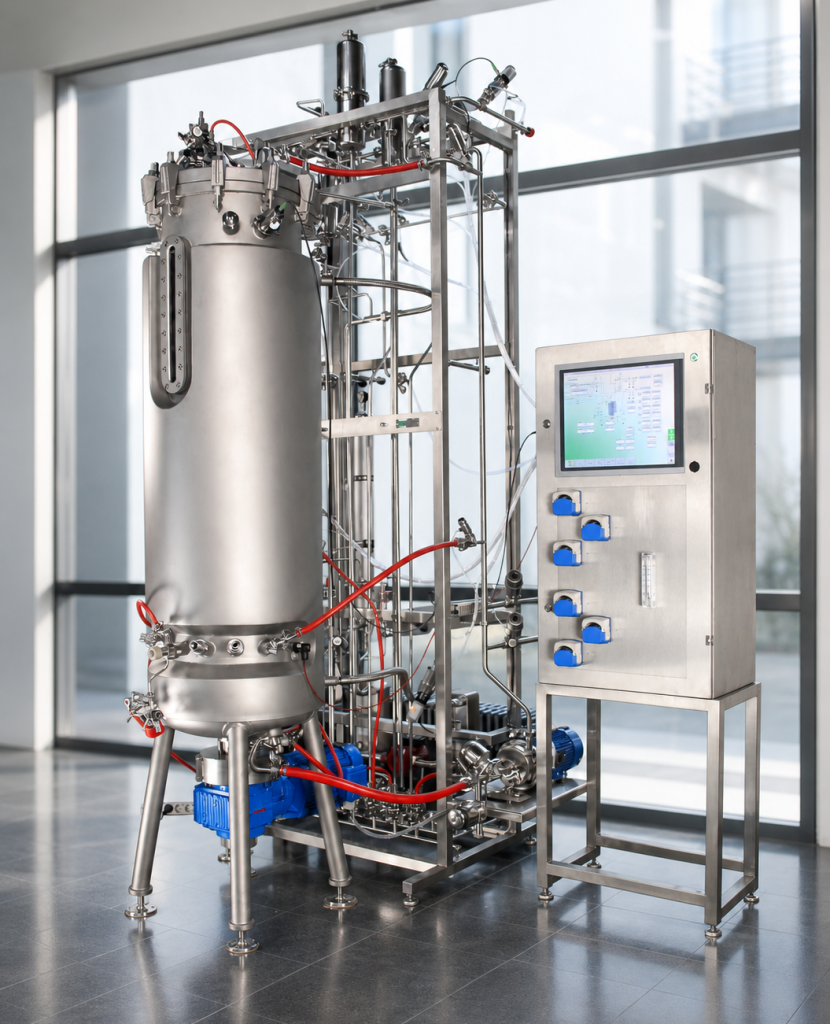
bbi-biotech can configure seed-to-main transfer concepts with sterilizable transfer lines, transfer-line SIP, bottom drain or transfer valves, pump or pressure transfer, cleaning concepts and coordinated xCUBIO sequences. Where required, the dedicated controllers of the seed and main fermenter exchange handshake signals to support defined transfer workflows.
xCUBIO automation beyond control loops – Sequence Editor, Valve Editor and Profile Editor for user-defined production workflows
xCUBIO does more than control individual process values. It allows users to build repeatable production workflows from sequence modules, saved valve states, mathematical profiles, sensor conditions and operator interactions.

xCUBIO Sequence Editor – Build production workflows step by step by yourself
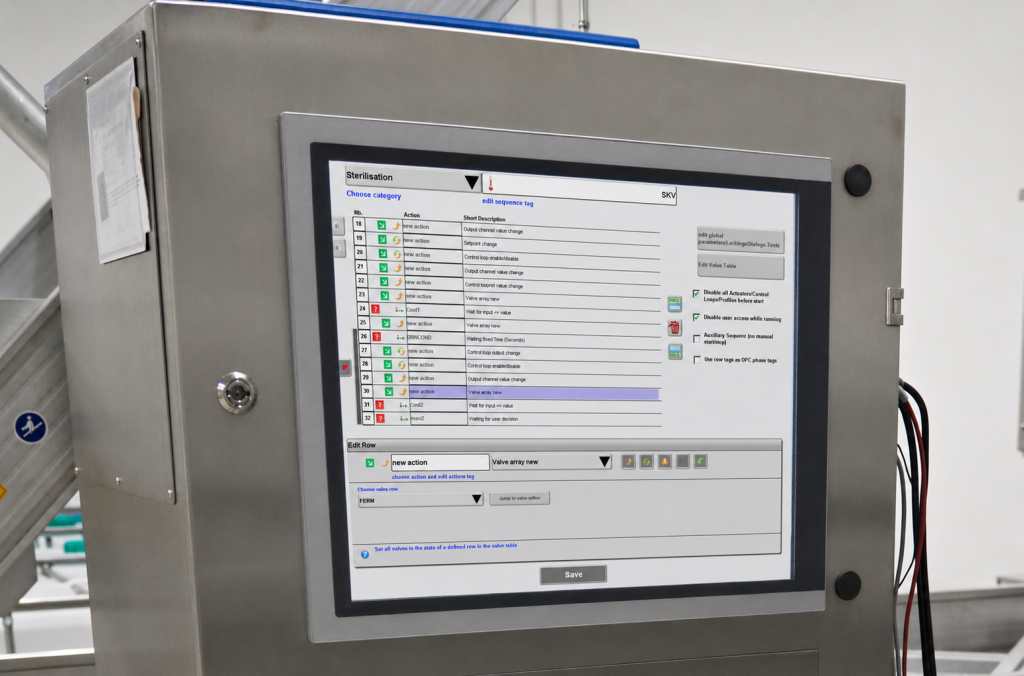
The xCUBIO Sequence Editor allows users to build process workflows line by line, with reusable logic, clear operator guidance and controlled process flexibility.
Each line can use a configurable sequence module, for example to set an output, wait for a defined time, wait for a sensor value, change a setpoint, request user acknowledgement, start a profile or call a saved valve state.
Factory-prepared sequences are supplied for recurring operations such as empty-vessel SIP or CIP-related workflows.
Users can copy, adapt and extend these sequences – or create new ones where the project scope, user rights and change-control concept allow it.
| Sequence module examples | What it enables |
|---|---|
| Set outputs | Set pumps, valves, signals or internal/external outputs |
| Wait conditions | Wait for time, sensor thresholds or input signals |
| Jump logic | Move to another sequence step when conditions are met |
| User acknowledgement | Display predefined information or warning messages |
| Setpoints and PID | Change setpoints or PID parameters during the workflow |
| Start / stop actions | Start or stop profiles, loops, sequences or process steps |

This turns automation into a practical workflow tool: Users can structure and automate recurring production tasks by themselves.
Valve Editor

Save valve states for reuse
The xCUBIO Valve Editor gives users a graphical view of the automatic valves in the system. Valve positions can be set by clicking on the displayed valves and saved as reusable valve states or valve tables.
These saved states can then be called from the Sequence Editor, so complete valve configurations become reusable building blocks for SIP, CIP, transfer, harvest or addition workflows.
Complex valve configurations can be prepared once, named and reused inside multiple sequences.

Profile Editor

Run mathematical process profiles
The xCUBIO Profile Editor links selected outputs or setpoints to defined time functions. Users can create linear, exponential or logistic profiles and start them manually or from sequences where the workflow requires it.
For example, a feed-pump profile can be started after a process condition indicates the transition into exponential growth. This allows biologically meaningful feeding strategies to become part of the automation concept.
Profiles make time-based process strategies easier to define, repeat and integrate into production workflows.

- Linear profiles for ramps and controlled transitions
- Exponential profiles for growth-related feeding strategies
- Logistic profiles for biological processes approaching a plateau

Control loops as foundation

Stable process control
Core control loops provide the stable basis for production operation. pH, DO, temperature, pressure, foam or feed-related parameters can be controlled, recorded and used as part of larger workflow logic.
Control loops are not isolated features; they can become part of sequences, conditions and automated production steps.
- pH, DO, temperature, foam
- Multi-Cascades
- Dynamically changeable in sequences and profiles
Process values as conditions

Data becomes logic
Sensor values, PAT signals, balances, external inputs and calculated values can be used as conditions inside automation workflows. They can trigger steps, hold a sequence or release the next operation.
Measured values should not only be visible. They should help decide when the next defined process step can happen.
- Sensor thresholds and input signals
- Balances and external analytics
- Conditions for sequence progress
Rights, data and integration

Controlled automation freedom
User rights and project configuration can define how freely sequences, valve states and profiles may be edited. This supports open process development as well as GMP-oriented restrictions where required.
Automation freedom can be provided where useful and restricted where validated production workflows require stronger control.
- User levels and access rights
- Data recording and export
- OPC UA for external connectivity

One platform across systems and scales
xCUBIO provides one consistent automation platform across different bioreactor types, process concepts and development stages.
Instead of forcing users to adapt to different controller logics as systems grow more complex, it creates a shared operating structure that supports comparability, faster familiarization, cleaner transfer of process logic and a more coherent path from early development to larger-scale operation.

Premium automation beyond conventional controller logic
A serious bioreactor controller must provide clear overview screens, reliable control loops and direct manual access where needed. xCUBIO does all of that as a matter of course – but its real strength lies far beyond conventional controller logic.
The platform combines real-time process visualization, integrated alarm handling, manual actuator access, profile functions, advanced sequences, data recording and export within one structured operating environment designed for significantly greater depth, flexibility and process control than a conventional controller typically offers.

Profiles, Sequence Editor & Valve Editor
This is where xCUBIO becomes especially powerful. Time-dependent profiles allow process values and actuator outputs to follow defined progressions instead of remaining static.
The graphical Sequence Editor and Valve Editor enable users to automate recurring process steps and genuinely process-driven routines without conventional programming including complex valve-position logic and valve state changes.
Together, these tools bring an unusual level of automation freedom to the user: powerful process logic without the need to build custom software for every advanced routine.

Built for flexible process architecture and connectivity
xCUBIO is designed for processes that do not fit into rigid standard architectures. Additional sensor technology, external devices and analytical signals can be integrated with exceptional flexibility, while pumps and other functions can be assigned in ways that reflect the real needs of the process rather than a predefined package logic.
At the same time, trend recording, CSV export, remote access via integrated VNC functionality and OPC connectivity support structured data use, system integration and future-ready automation concepts.

Automation
Sequence Editor
Valve Editor
Complex Recipes

Flexibility
Sensor Choice
Gasmix Configs
Control Possibilities

Visualization
19″ Touch-Screen
Trend-Displays
Live Visualization

Connectivity
Remote Access
OPC Interfaces
Export Features
The result is a production automation environment, not only a controller. xCUBIO can combine control loops, sensor conditions, sequence modules, saved valve states and mathematical profiles into workflows that reflect how the production process is actually operated.
Documentation, FAT and qualification support
Production bioreactor documentation should match the project scope, regulatory expectations and customer-side qualification strategy. bbi-biotech can provide technical documentation, FAT records, automation documentation and qualification support according to the agreed scope.
Project documentation

Technical project basis
Project documentation can include component lists, as-built P&ID, wiring diagrams, calibration certificates, spare-parts information and manuals. The documentation package is defined around the delivered system, configured options, project scope and customer requirements.
Typical scope
- Main component list and manuals
- As-built P&ID and wiring diagrams
- Calibration certificates and spare-parts list
FAT and SAT support

Tested before delivery
FAT is part of the project execution and documents functional testing before delivery. SAT can be supported where requested, especially when installation, utilities, site interfaces or customer-side acceptance procedures require additional on-site verification.
Typical scope
- Factory acceptance test documentation
- SAT support where requested
- Functional checks before handover
Qualification support
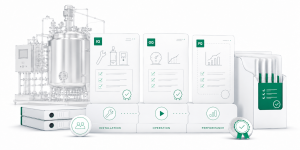
IQ/OQ/PQ assistance
IQ/OQ templates and support can be provided where required, and PQ support can be discussed for customer-specific validation strategies. bbi-biotech supports qualification work without taking over the customer’s full validation responsibility.
Typical scope
- IQ/OQ documentation templates
- IQ/OQ support where required
- PQ support where applicable
Automation documentation

Software and data context
Automation documentation can include software channel documentation, prepared sequence documentation, user-level information, data-recording concepts and interface descriptions. xCUBIO can support GAMP- and CFR 21 Part 11-oriented documentation and data handling.
Typical scope
- Software channel documentation
- Prepared sequence documentation
- Data handling and OPC UA context
Documentation is defined with the project. From technical as-built documents to FAT records, automation documentation and qualification support, the scope should be aligned early with the customer’s production, QA and regulatory expectations.
Application paths for production bioreactors
Production bioreactor projects differ by biology, process mode, sterility level, oxygen demand, shear sensitivity, documentation requirements and production strategy. bbi-biotech configures production vessels, transfer paths, utilities, SIP/CIP, automation and documentation around the intended application – from pharma-oriented sterile production to emerging food, cell-culture and sustainable-biotech processes.
Biopharma production

Sterile production with documentation focus
Biopharma production requires sterile process paths, defined documentation, controlled automation and reliable SIP/CIP workflows. Vessel design, utilities, transfer logic and user rights should be planned together from the beginning.
Production value
Built for customers who need robust sterile operation, traceable workflows and GMP-oriented project execution.
- Sterile vessel and transfer concepts
- Documentation and qualification support
- Controlled xCUBIO automation workflows
Cell-culture production

Sensitive cells, controlled environments
Cell-culture production requires gentle mixing, controlled gas strategy, sterile additions and careful process monitoring. The system must support sensitive biology without forcing it into microbial fermentation assumptions.
Production value
A strong fit where shear, gas control, feeding, sterility, cell viability and process automation quality matter.
- Gentle agitation and gas control
- Sterile additions and feed profiles
- Cell-culture-ready process automation
Precision fermentation

Expression-based biomanufacturing
Precision fermentation needs reproducible production conditions, controlled feeding, oxygen transfer, foam handling and stable batch execution. Production systems must support both biological performance and repeatable industrial operation.
Production value
Designed for expression processes where feed strategy, automation and batch consistency drive productivity.
- Fed-batch and profile-based feeding
- Oxygen transfer and foam strategy
- Repeatable production sequences
Custom production trains
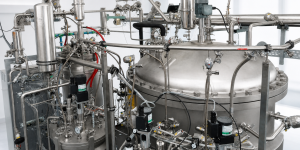
Project-specific process architecture
Custom production trains go beyond one vessel. Seed reactors, main vessels, media/feed/additive units, transfer lines, SIP/CIP paths, valve automation, utilities and documentation must be engineered together as one fully integrated production system.
Production value
Best for complex production projects where architecture must be clarified before final quotation and pre-engineering.
- Seed, main and auxiliary vessels
- Transfer, SIP/CIP and valve logic
- Pre-engineering before quotation

Cellular agriculture & cultivated meat
Cellular agriculture needs sterile handling, gentle mixing, scalable feeding and controlled cell growth. bbi-biotech systems can support cultivated meat, cell biomass, fat-cell, muscle-cell and cell-based ingredient production.

Seed-to-production fermentation
Microbial production often depends on seed preparation, sterile transfer and robust main-vessel operation. bbi-biotech systems can connect inoculum strategy, SIP-ready transfer paths, oxygen demand, foam control and production timing.

High-cell-density fermentation
High-cell-density fermentation can push oxygen transfer, heat removal, feeding, foam control and exhaust handling to their limits. bbi-biotech systems can be engineered around real process load and production constraints.

Industrial biotech & specialty chemicals
Industrial biotech projects need durable stainless-steel vessels, utility integration, process piping and flexible automation. bbi-biotech systems can support enzymes, chemicals, polymers, biosurfactants and industrial fermentation.

CO₂ capture & gas fermentation
Gas fermentation and carbon utilization require strong gas strategy, mass transfer, pressure concept, exhaust handling, safety and analytics. bbi-biotech systems can support CO₂, H₂, CO, methane or C1-based processes and workflows.

Food ingredient production
Food ingredient production can include enzymes, proteins, mycoprotein, aromas or functional ingredients. bbi-biotech combines cleanable stainless-steel design, reproducible batches and production-friendly automation.

Personal-care ingredients
Cosmetics and personal-care applications involve polysaccharides, peptides, enzymes, hyaluronic acid or fermentation-derived bioactives. bbi-biotech supports clean operation, material compatibility and batch quality.

Biological soil-health products
Biological soil-health applications include microbial inoculants, biostimulants, biofertilizers and agricultural bioproducts. bbi-biotech supports scalable fermentation, robust operation, feed, harvest and downstream interfaces.
The application defines the system. Working volume, vessel geometry, gas strategy, shear profile, feed concept, sterile transfer paths, SIP/CIP, automation and documentation should be selected around the real production process – not around a fixed standard platform.
Example production configurations
Production bioreactor projects can range from a single stainless-steel production vessel to complete seed-to-main fermentation lines and larger production systems. The examples below show typical configuration logic; final specifications always depend on process requirements, available utilities, documentation needs and project scope.
Cell culture production platform with sterilizable transfer line

An xCUBIO in-situ setup combining a 20 L seed reactor with a 100 L production reactor.
The system was designed around a sterilizable transfer concept between both vessels, with the transfer line integrated into the software functions and CIP, and prepared for separate sterilization.
50 L + 200 L microbial seed-to-main production setup
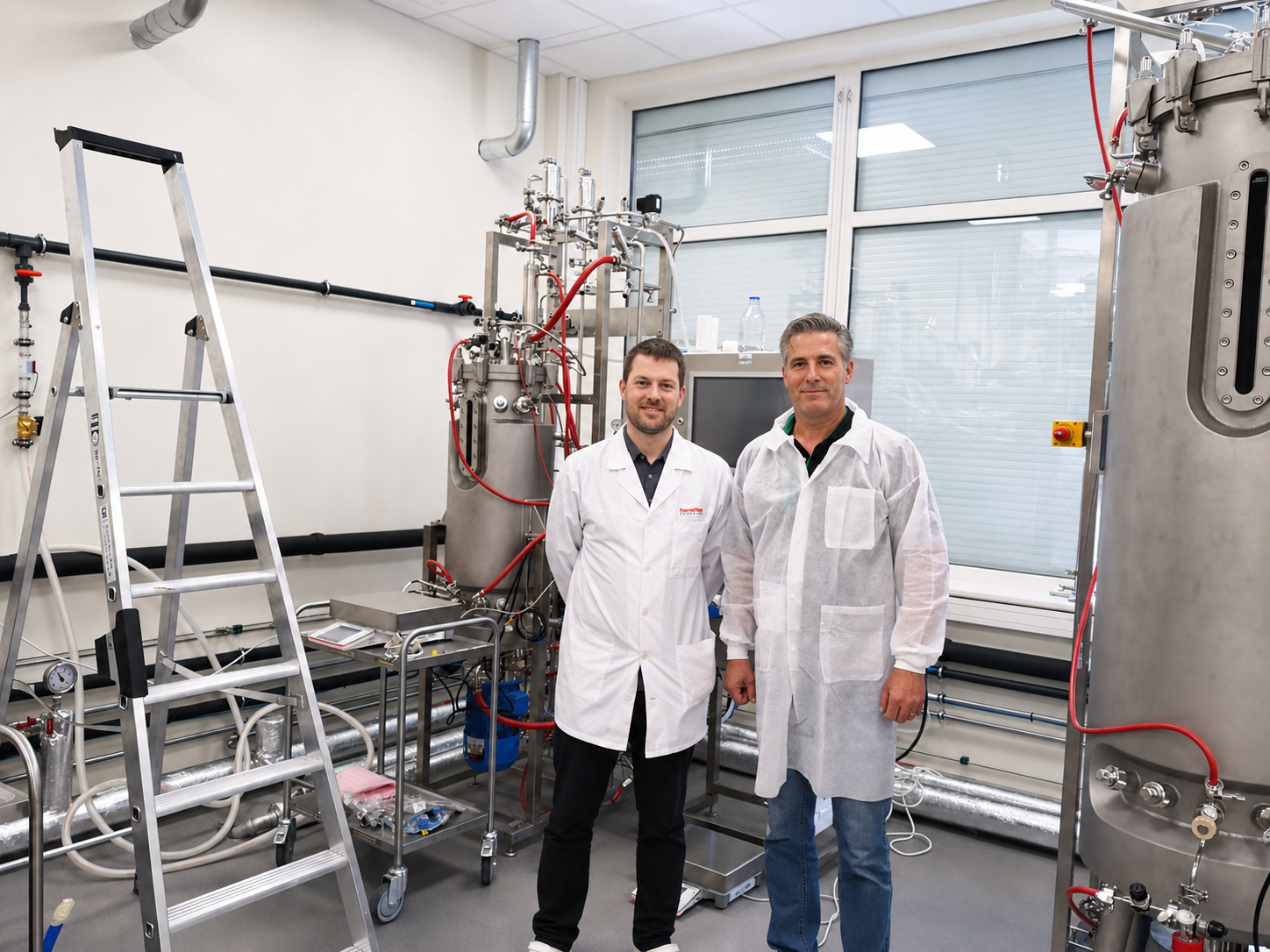
A microbial seed-to-main production setup combines 50 L and 200 L working volume vessels with a sterilizable transfer line.
The system was designed for controlled microbial scale-up, sterile transfer between both reactors and coordinated xCUBIO automation.
Production line with 2000 L reactors for cosmetic ingredients – extended multiple times
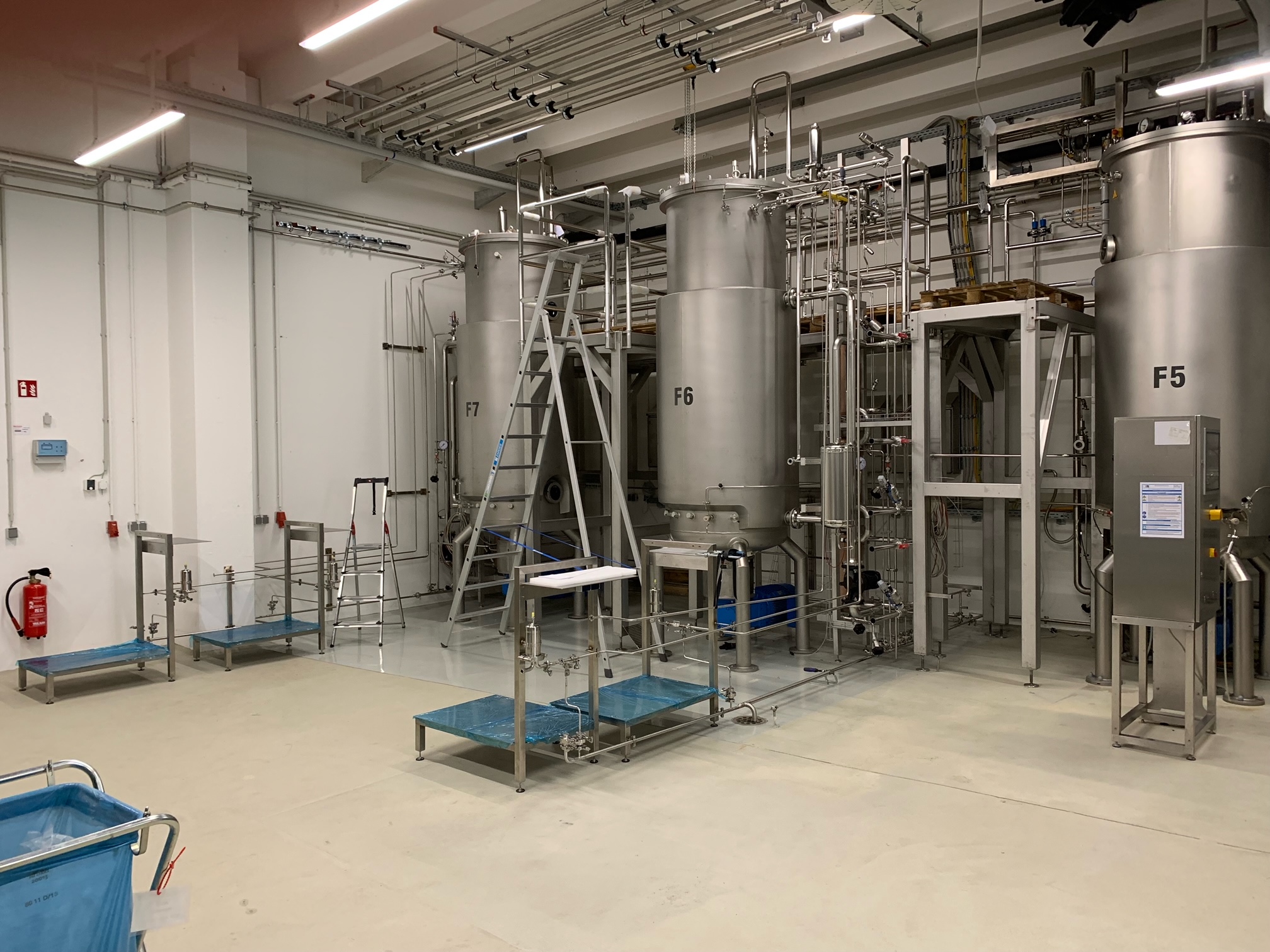
A repeatedly expanded production installation for a European cosmetic-ingredient manufacturer uses xCUBIO automation in multiple 2000 L reactors.
Additional 2000 L reactors were integrated to increase capacity while maintaining one consistent automation and operating philosophy.
Production setup in Germany up to 7000 L for soil health application

A production-oriented project for soil health applications uses xCUBIO automation in vessels up to 7000 L culture volume .
Multiple xCUBIO control units were coordinated to create a consistent automation architecture including units for media preparation.
These examples are configuration patterns, not fixed standard packages. bbi-biotech defines production systems around the customer’s process, utilities, sterile transfer needs, automation logic and documentation requirements.

Start a production bioreactor concept discussion
Production bioreactor projects are easiest to define when process, vessel scope, sterile transfer paths, utilities, automation and documentation needs are discussed early. Whether you are planning a single production vessel, a seed-to-main train or a complete stainless-steel process system, bbi-biotech can help structure the next step.

Discuss a production bioreactor concept
Early project orientation
For early-stage projects where the working volume, process goal, transfer concept, SIP/CIP scope or automation level still need to be clarified.
Best for
- First production-scale discussions
- Volume range and process strategy
- Sterile transfer and SIP/CIP orientation
Request a configured production bioreactor quote
Defined project requirements
For projects where the application, working volume, vessel material, automation concept or documentation expectations are already partly defined.
Best for
- Single production bioreactors
- Seed + main fermenter systems
- Project-specific stainless-steel configurations
Discuss pre-engineering and architecture
Complex production systems
For larger production projects where P&ID, layout, vessel scope, utilities, transfer paths and documentation are defined before quotation.
Best for
- Complete production trains
- SIP/CIP-integrated systems
- Utility, piping and automation concepts
Not sure which path fits your project? Start with a concept discussion — we can help define the right scope before quotation.
Direct contact to Berlin head office
+49 (0)30 221 800 10
info@bbi-biotech.com
bbi-biotech GmbH
Landsberger Str. 259
12623 Berlin