
xCUBIO multi gives process development teams a reusable and configurable route to parallel cultivation – from standard stirred bioreactor configurations with up to 12 vessels to high-throughput vessel configurations with up to 24 vessels.
Designed for teams that need reproducible multi-vessel data, flexible sensor integration, modular automation and lower dependency on project-specific single-use consumables.
- Up to 12 standard stirred bioreactors
- Reusable vessel concepts
- For process development & DoE
- For Cell Culture & Microbial Fermentation
- Up to 24 high-parallel vessels
- Open sensor integration
- Lower consumable dependency
- Independent control for each vessel in every aspect

Choose the right parallel configuration
xCUBIO multi can be configured for deeper per-vessel process control or for higher-parallel studies with simplified reusable vessel concepts. The right choice depends on your process, required sensor depth, vessel concept and number of parallel cultivations.
Standard stirred bioreactor configurations
For parallel work with real stirred bioreactors, shaft-driven agitation and broader sensor and control options.

xCUBIO multi configurations with standard bioreactor vessels are designed for users who need strong process comparability, flexible vessel concepts and deeper control of each cultivation.
Best for: controlled process development, microbial fermentation, cell culture optimization, scale-up preparation and studies where each vessel should behave like a full laboratory bioreactor.
- Standard stirred bioreactor setup
- 2 vessels per supply tower
- Each vessel independently instrumented and controlled
- Up to 6 supply towers / up to 12 vessels
- Broad sensor and control flexibility
- Reusable glass or autoclavable vessel concepts
High-parallel vessel configurations for high-throughput
For higher-parallel studies with reusable vessel concepts such as GL45, GLS80 and airlift reactors.

xCUBIO multi high-throughput configurations are designed for users who need more parallel cultivations while keeping hardware reusable and consumable dependency low.
Best for: screening, feasibility studies, media comparison, higher-parallel parameter studies and applications where vessel number matters more than full stirred-tank instrumentation.
- GL45, GLS80 and airlift vessel concepts
- 4 vessels per supply tower
- Each vessel operated as an independent cultivation unit
- Up to 6 supply towers / up to 24 vessels
- Magnetic stirring or airlift circulation
- Reduced sensor interfaces per vessel
A reusable alternative to single-use-heavy parallel platforms
Single-use parallel bioreactor platforms can be powerful for standardized high-throughput workflows. xCUBIO multi offers a different route: reusable vessel concepts, configurable hardware, open sensor integration and lower dependency on project-specific consumables – especially valuable for repeated development studies, non-standard processes and long-term platform use.
Lower recurring consumable costs

Reusable vessels instead of project-specific disposables
For repeated parallel studies, consumables can become a relevant part of the operating budget. Reusable vessel concepts help reduce dependency on single-use vessel formats and can lower recurring consumable costs over time.
Especially valuable when repeated parallel studies make vessel consumables a recurring cost driver.
- Reduces dependency on disposable vessel formats
- Supports repeated use across many studies
- Can lower recurring consumable costs over time
- Helps make long-term process development budgets predictable
More freedom in process configuration

Configure the vessel concept around the process
xCUBIO multi is not limited to one fixed vessel format. Depending on the selected configuration, glass vessels, bottle-based concepts, airlift vessels and selected autoclavable vessel options can be used to match the process more closely.
The process conditions and customer needs define the platform configuration – not the other way around.
- Supports different reusable vessel concepts
- Allows process-specific hardware choices
- Better suited for applications that do not fit one fixed format
- Useful for microbiology and cell culture workflows
Reusable hardware for long-term availability

Less dependence on a single consumable supply chain
Single-use-heavy workflows can create dependency on specific vessel formats, consumable availability and supplier lead times. Reusable vessel concepts can make long-term process development less dependent on one disposable supply chain.
A reusable platform stays productive when consumable availability, lead times or format changes become critical.
- Reduces reliance on one disposable vessel format
- Supports long-term platform use without vendor lock-in
- Helps avoid consumable-format lock-in
- Useful when supply security matters
Better fit for non-standard processes

Configurable hardware for every biological process
Some processes need unusual vessel geometries, specific gas handling, different mixing concepts, special sensor access or adapted sampling strategies. Reusable configurable hardware gives more room to adapt to the technical requirements.
When the biological process is not standard, the bioreactor platform should not force it into a standard disposable format.
- Supports adapted vessel geometries
- Allows application-specific mixing and gas concepts
- Can accommodate special sensor or sampling needs
- Useful for development work outside standard workflows
Standard stirred or high-parallel – which setup fits your study?
Both configuration levels use the same xCUBIO multi automation logic, with each vessel operated as an independent cultivation unit. The difference lies mainly in vessel number, mixing concept, temperature-control concept and how many sensor, pump and interface options need to be integrated per vessel at the same time.
| Standard stirred | High-parallel |
|---|
| Vessel count | Up to 12 | Up to 24 |
| Vessel per tower | 2 vessels per tower | 4 vessels per tower |
| Operation | Independent control per vessel | Independent control per vessel |
| Vessel concepts | All vessel concepts | GL45, GLS80, airlift |
| Mixing | Motor-driven shaft agitation | Magnetic stirring or airlift circulation |
| Temperature | Double-wall, heating mat or Peltier | Heating mat |
| Sensors & pumps | Broad options, high simultaneous integration depth | Broad options, focused simultaneous integration per vessel |
| Instrumentation philosophy | Open sensor integration | Open sensor integration, adapted to vessel density |
| Trade-off | Fewer vessels, deeper per-vessel setup | More vessels, no double-wall or motor shaft stirring |
| Best for | Deep process control and stirred-tank comparability | Higher-parallel reusable studies and efficient screening |
In short: Standard stirred maximizes per-vessel process depth; high-parallel maximizes vessel number while keeping reusable hardware and independent xCUBIO control.


Designed for demanding process development work
xCUBIO multi is built for teams that need more than isolated single-vessel experiments — supporting structured comparison, reproducible process data, configurable vessel concepts and repeated development campaigns on one modular platform.
Upstream process development
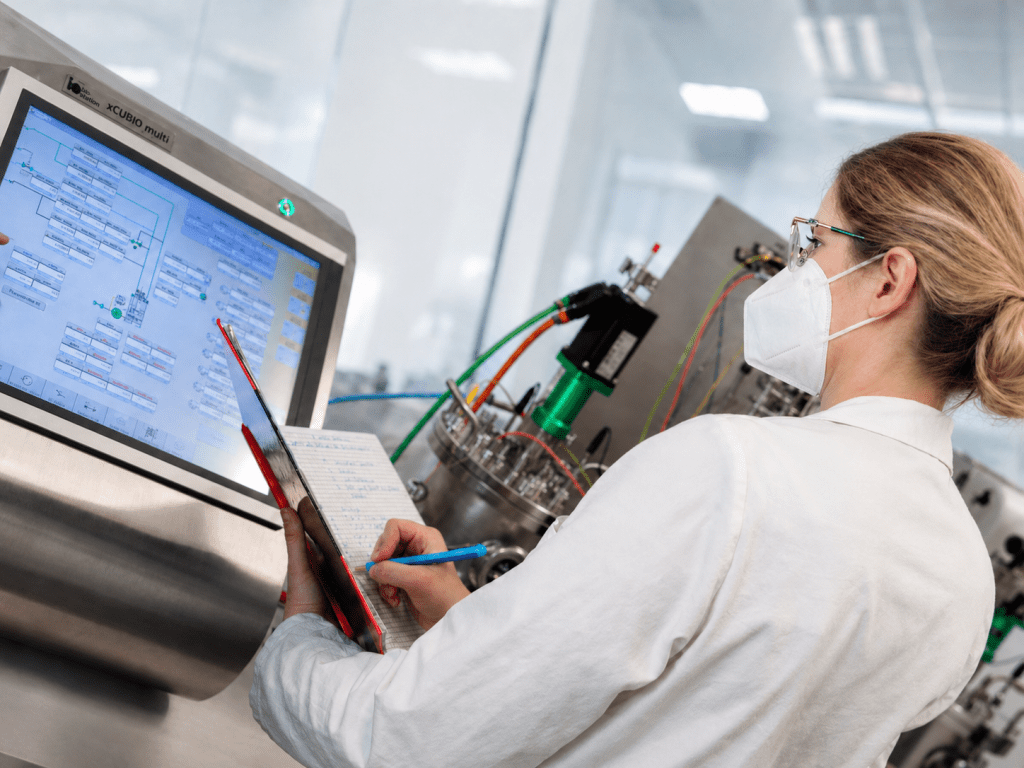
Compare media, feed strategies, strains, clones or process parameters across multiple controlled vessels.
- For teams that need parallel process data instead of sequential single-vessel comparison runs.
Process characterization & DoE

Run structured experimental matrices where comparability, repeatability and controlled process conditions matter.
- Useful for parameter studies, robustness work and development campaigns with many conditions.
Scale-up preparation
Generate laboratory-scale data that helps support process understanding before moving into pilot or production systems.
- Especially relevant when parallel results should guide the next scale decision.
Long-term platform use
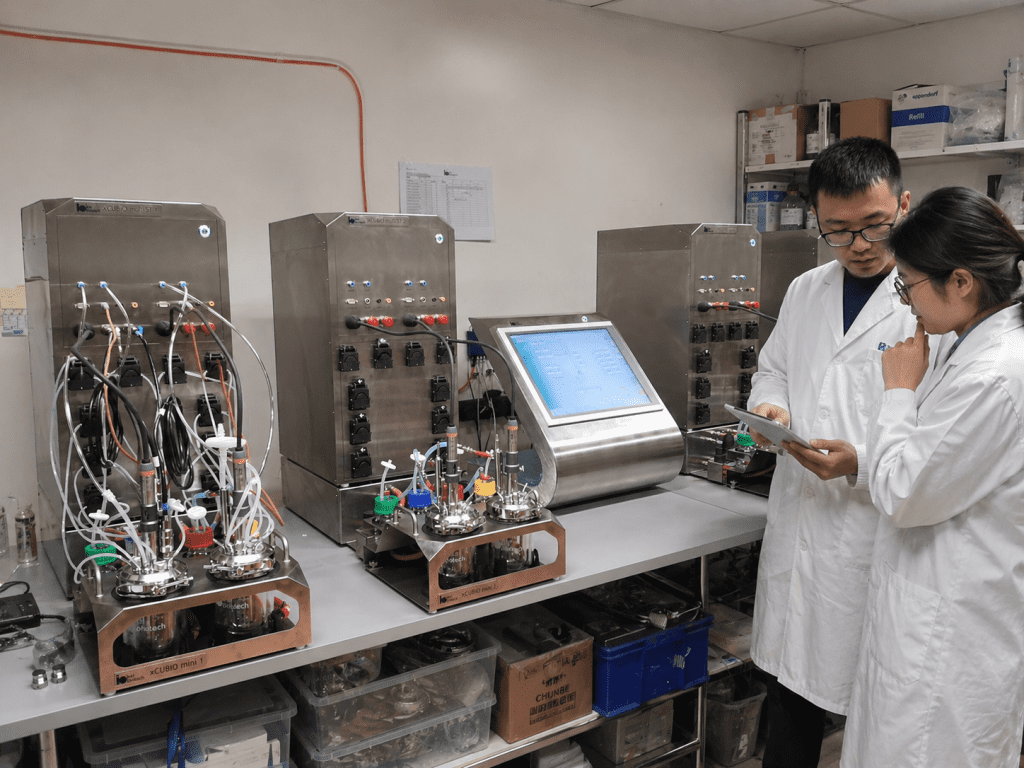
Use reusable hardware, open sensor integration and modular expansion instead of relying on one fixed disposable format.
- For teams that expect repeated studies, changing applications or evolving instrumentation needs.
When should you choose xCUBIO multi?
Choose xCUBIO multi when your process development work depends on reproducible comparison across multiple independently operated vessels – with reusable hardware, flexible instrumentation and one consistent xCUBIO automation logic.

You need to compare more conditions
Run media, feed, strain, clone or process-parameter comparisons in parallel instead of working through one vessel run after another.
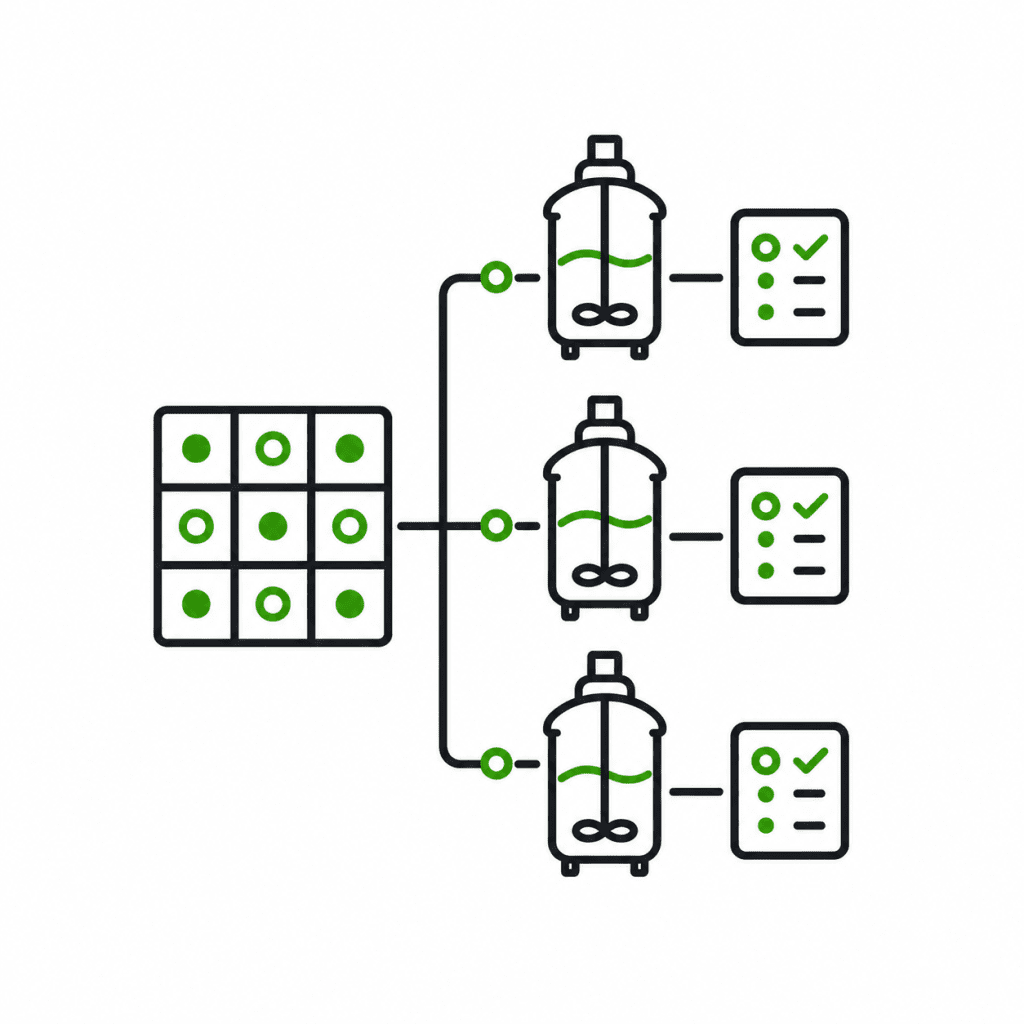
Your study requires DoE or process characterization
Use multiple controlled vessels to investigate parameter combinations, process windows and robustness questions under comparable conditions.

You want to reduce sequential development loops
Parallel operation can help shorten development cycles by generating more relevant process data within the same campaign.

You need independently controlled vessels
Each vessel runs as an individual cultivation unit, while the overall system remains part of the same unified xCUBIO automation concept.

You repeat parallel studies regularly
Reusable vessel concepts can reduce recurring consumable dependency when parallel studies become part of your routine workflow.

Your process does not fit one fixed format
Choose configurable vessel concepts, open sensor integration and modular xCUBIO options when your application needs more freedom than a fixed platform allows.
How the modular supply-tower architecture works
Start with the number of vessels your studies require and expand step by step – with one central xCUBIO multi controller and independently operated vessels across the entire setup.

One central xCUBIO multi controller –
Process overview on 19″ touchscreen
Add xCUBIO supply towers step by step. –
Scale from a smaller setup to larger parallel configurations without changing the operating concept.
Each vessel remains an independently operated cultivation unit – not just one position in a shared setup.
Independent vessels, comparable data
xCUBIO multi treats every vessel as an individual bioreactor. Each vessel can run its own process strategy, while the complete installation remains operated through one consistent xCUBIO automation environment.
True parallel operation means that each vessel can follow its own setpoints, profiles, feeds, control loops and process sequence – without forcing all vessels into one shared process.
Each vessel is an individual bioreactor
Each vessel can be operated as its own independent cultivation unit, while the complete setup follows the same unified xCUBIO automation logic across all connected vessels.
Different strategies in the same run
Compare different pH, DO, feed, gas, temperature, substrate or agitation strategies side by side in controlled vessels instead of repeating separate runs one after another.
Comparable data without shared control logic
The operating environment stays consistent across all vessels, but the process control remains independent. This helps generate comparable data without reducing the vessels to positions in one shared batch.
True parallel operation – not shared batch operation.
Improve turnaround with prepared reusable vessel sets
Reusable parallel workflows can be fast when preparation is planned in parallel. While one vessel set is running, a second reusable vessel set can be cleaned, assembled and prepared for the next campaign.

Prepare the next run in parallel and save time
While one vessel set is in use, another set can be cleaned, assembled, checked and prepared for the next campaign.
Reduce downtime between multiple batches
Successful teams can reduce the turnaround time between batches to around one hour in suitable pre-prepared vessel workflows.
Lower recurring consumable dependency
Reusable vessel sets reduce the need to purchase and manage a new disposable vessel assembly for every parallel run.
Reduce recurring disposable vessel waste
Repeated parallel campaigns can generate a substantial disposable vessel stream. Reusable concepts reduce this recurring material flow.
In repeated parallel campaigns, reusable vessel sets help reduce dependency on disposable vessel consumables while keeping turnaround workflows efficient.
Parallel process development with real vessel choices
xCUBIO multi is built for parallel process development with real reusable vessels – from stirred-tank bioreactors to bottle-based and airlift concepts. Instead of adapting your study to one fixed reactor format, the vessel concept can be selected around the process.
Double-wall vessels
250 ml – 10 L | Universal stirred glass vessel with double-wall

Single-wall vessels
250 ml – 10 L | Stirred glass vessel with single wall and heating mat

Stainless steel vessels
2 L – 10 L | Autoclavable stainless-steel vessel with sight glass

Airlift vessels
500 ml – 10 L | Airlift circulation without mechanical stirring

GL 45 reactor vessels
250 ml – 50 L | Low-cost bottle-based reactor concept

GLS 80 reactor vessels
250 ml – 50 L | Bottle-based reactor concept

Vessels with bottom outlet
500 ml – 10 L | Bottom outlet for transfer, harvest and circulation

Special geometry vessels
500 ml – 10 L | Adapted vessel geometry for special requirements

Open sensor integration, not fixed instrumentation
xCUBIO multi is not locked into one predefined sensor, pump or instrumentation package. The platform is designed to integrate a broad range of bioreactor sensors, actuators and process signals – so your study can be configured around the process, not around the limits of a fixed system architecture.


Broad sensor choice
Integrate established bioreactor sensors for pH, DO, pCO₂, biomass/OD, off-gas O₂/CO₂, redox, conductivity, pressure, temperature, foam and level.

Advanced process data
Combine classical bioreactor control signals with biomass monitoring, off-gas analysis and additional process data to build a more complete picture of each cultivation.

Flexible actuators and feeding
Configure pumps, balances, feeds and other actuators around the study design instead of adapting the process to a fixed hardware layout.

Open integration pathways
Integrate analog and digital signals, Modbus, OPC UA, RS232/RS485, Ethernet, USB or selected manufacturer protocols where required and technically approved.
Reduce vendor lock-in and keep more freedom in sensor, pump and instrumentation choices.
Process visibility, data access and integration
xCUBIO multi gives teams live visibility into each vessel, records structured batch data and provides export and interface options for external analysis, documentation and integration into existing automation and data environments.

Process visibility
Follow real-time and historical trends, process values and complete alarm history directly on the xCUBIO controller for each vessel.

Structured data
Record structured batch data, process values, trends and alarms so runs can be reviewed, documented and transferred into downstream analysis workflows.

Raw data export
Export batch data and raw process data, including CSV-based exports, for external evaluation, reporting and process-development analysis.

Integration
Connect xCUBIO multi to supervisory and data systems via OPC UA, or OPC DA when required for legacy environments such as older MFCS-based setups.
Data-integrity-oriented concepts can be considered during project configuration when required. Remote access and remote monitoring can be enabled where useful and disabled where site IT or security requirements do not allow it.
Reference projects
References, project examples and real implementations show how broadly xCUBIO multi can be used in different applications.
Parallel cell culture platform for an East-Asian CDMO

A parallel xCUBIO setup for cell culture studies configured with 250 mL double-wall vessels, four supply towers and full sensor equipment.
The system was designed to support controlled and reproducible parallel studies under clearly defined process conditions, with a configuration suited for structured monitoring and comparative evaluation.
Parallel cell culture platform with dissolved CO₂ sensors

A customized xCUBIO twin/multi setup for parallel 5 L reactors combined a multi controller architecture with dedicated CO₂ process integration.
The platform was prepared for Mettler-Toledo dissolved CO₂ probes and supported by CO₂ mass-flow control and pCO₂-oriented automation functions.
Phototrophic platform in New Zealand with later expansion

An xCUBIO phar multi bubble first supplied with 8 × 1 L vessels and later expanded to 16 bubble-columns with 16 dedicated illumination units.
The system was configured with tailored wavelengths and advanced automation features for phototrophic process development.
Stainless-steel system for pharmaceutical development

An xCUBIO multi setup with four supply towers and 5 L stainless-steel vessels, configured for demanding parallel bioprocess development.
The system included integrated pressure control, standard bioprocess sensors, additional cell density and viability monitoring, and a custom flexible gas-mixing concept for adaptable process operation.
Automation & Control with xCUBIO – one consistent automation platform across all reactor types and scales
xCUBIO brings structured operation, advanced process logic and flexible integration into one coherent automation environment across bbi-biotech bioreactor systems. From benchtop and parallel glass systems to SIP-capable stainless-steel pilot and production bioreactors, users work with one consistent automation philosophy instead of fragmented controller generations.
The result is a shared control logic for process development, scale-up, production and retrofit projects – supporting familiar operation, scalable process logic and flexible integration across reactor types and vessel concepts.


One platform across systems and scales
xCUBIO provides one consistent automation platform across different bioreactor types, process concepts and development stages.
Instead of forcing users to adapt to different controller logics as systems grow more complex, it creates a shared operating structure that supports comparability, faster familiarization, cleaner transfer of process logic and a more coherent path from early development to larger-scale operation.

Premium automation beyond conventional controller logic
A serious bioreactor controller must provide clear overview screens, reliable control loops and direct manual access where needed. xCUBIO does all of that as a matter of course – but its real strength lies far beyond conventional controller logic.
The platform combines real-time process visualization, integrated alarm handling, manual actuator access, profile functions, advanced sequences, data recording and export within one structured operating environment designed for significantly greater depth, flexibility and process control than a conventional controller typically offers.

Profiles, Sequence Editor & Valve Editor
This is where xCUBIO becomes especially powerful. Time-dependent profiles allow process values and actuator outputs to follow defined progressions instead of remaining static.
The graphical Sequence Editor and Valve Editor enable users to automate recurring process steps and genuinely process-driven routines without conventional programming including complex valve-position logic and valve state changes.
Together, these tools bring an unusual level of automation freedom to the user: powerful process logic without the need to build custom software for every advanced routine.

Built for flexible process architecture and connectivity
xCUBIO is designed for processes that do not fit into rigid standard architectures. Additional sensor technology, external devices and analytical signals can be integrated with exceptional flexibility, while pumps and other functions can be assigned in ways that reflect the real needs of the process rather than a predefined package logic.
At the same time, trend recording, CSV export, remote access via integrated VNC functionality and OPC connectivity support structured data use, system integration and future-ready automation concepts.

Automation
Sequence Editor
Valve Editor
Complex Recipes

Flexibility
Sensor Choice
Gasmix Configs
Control Possibilities

Visualization
19″ Touch-Screen
Trend-Displays
Live Visualization

Connectivity
Remote Access
OPC Interfaces
Export Features

Tell us about your parallel bioreactor project
Whether you are planning parallel process development, comparing standard stirred and high-parallel reusable configurations, evaluating vessel concepts or preparing a defined xCUBIO multi request, we will route your enquiry to the right team and next step.

I want to discuss my application
For early project discussions, process requirements, vessel selection, automation options, scale-up paths and technical feasibility questions.
I need a bioreactor quote
For defined system requests, planned purchases, quotation preparation or projects where required options are already reasonably clear.
I need service or spare parts
For running systems, service cases, complete vessel and spare parts needs, or selected upgrade or hardware requests and questions.
Direct contact to Berlin head office
+49 (0)30 221 800 10
info@bbi-biotech.com
bbi-biotech GmbH
Landsberger Str. 259
12623 Berlin