
xCUBIO single and xCUBIO twin are configurable benchtop bioreactor systems for controlled laboratory cultivation, microbial fermentation, mammalian cell culture, method development and early process development – with flexible vessel concepts, advanced gas handling, high pump capacity, sensor integration and advanced xCUBIO automation.
- xCUBIO single: 1 fully controlled benchtop bioreactor
- 250 ml – 10 L standard benchtop vessel range
- Up to 16 pumps and up to 12 MFCs for xCUBIO single
- For microbial fermentation, cell culture and process development
- xCUBIO twin: 2 independent vessels in one compact system
- Double-wall glass, single-wall glass and autoclavable stainless-steel vessels
- Up to 8 pumps and up to 6 MFCs per vessel for xCUBIO twin
- Advanced gassing, sensors, sampling and data integration
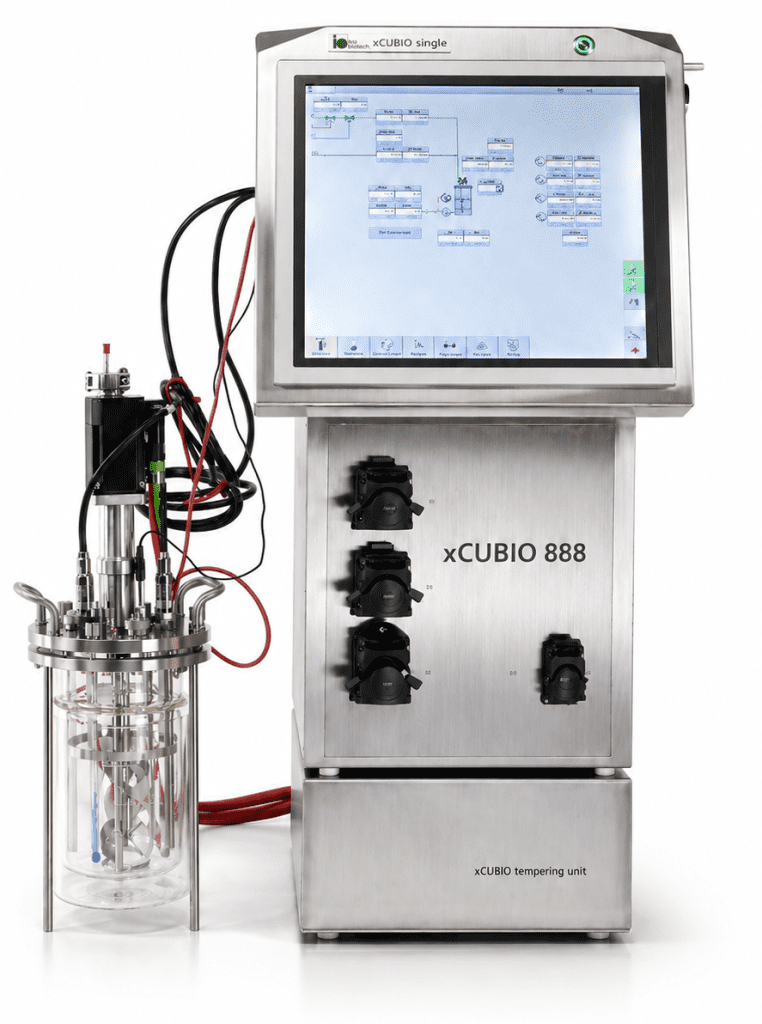
xCUBIO single or xCUBIO twin?
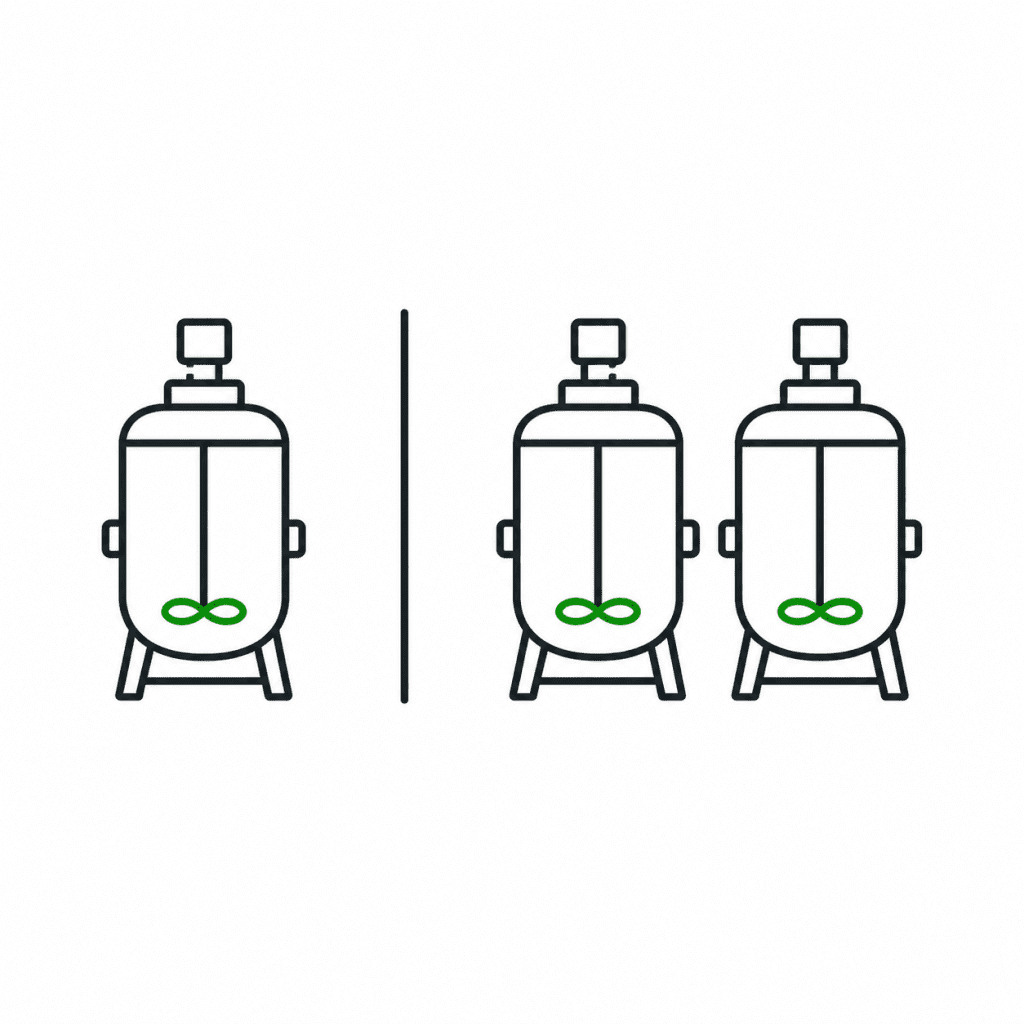
Both systems use the same xCUBIO automation philosophy and flexible vessel concepts. The right choice depends on your workflow: one fully configurable vessel for focused process work, or two independent vessels in one compact system for comparison, Scale-in-One and two-vessel process development.
xCUBIO single – Bioreactor with 1 vessel

One-vessel benchtop system – For focused process work with one highly configurable benchtop bioreactor.
Choose xCUBIO single when you need one fully controlled vessel for microbial fermentation, cell culture, method development or a special laboratory application – with flexible vessel, pump, gas, sensor and automation options.
Best for
- Laboratories that need one flexible bioreactor instead of a fixed standard package
- Focused single-vessel process development
- One organism, cell line or method at a time
- Demanding laboratory cultivation with high configuration depth
xCUBIO twin – Bioreactor with 2 vessels

Two-vessel benchtop system – For two independent vessels in one compact and cost-efficient automation platform.
Choose xCUBIO twin when you need two independently operated vessels without purchasing and installing two separate single bioreactors. It is ideal for side-by-side comparison, seed/process workflows and Scale-in-One.
Best for
- Saving bench space and investment compared with two separate single systems
- Two-vessel comparison studies
- Scale-in-One workflows with different vessel sizes
- Seed and process vessel concepts
Need more than two vessels? For larger parallel process-development setups, xCUBIO multi extends the same automation philosophy to higher vessel counts.
One xCUBIO benchtop platform, configured around your process
xCUBIO single and xCUBIO twin are not fixed standard packages. Beyond the number of vessels, each system is configured around the application – from vessel type and temperature-control concept to pumps, gas handling, sensors, sampling and automation level.
Workflow?
One vessel or two independent vessels?

Vessel?
Double-wall or single-wall? Type? Size?

Instrumentation?
Pumps, gas handling & sensor selection?
There are two ways to define an xCUBIO benchtop system: start from a typical application-based setup, or specify every configuration level in detail.


Both paths lead to the same xCUBIO automation platform – the difference is how deeply the system is specified before quotation.
Choose your vessel type and temperature-control concept
Temperature control is one of the first configuration decisions for an xCUBIO benchtop system. Double-wall glass vessels with water tempering are the standard concept, while single-wall glass vessels with heating mantle are a popular alternative for laboratories that prefer simpler handling, fewer water connections and a more compact bench setup. For more demanding applications, autoclavable stainless-steel vessels and other special vessel designs are available as an option.
Double-wall glass vessel with water tempering – Standard jacketed concept

The double-wall glass vessel is the standard xCUBIO benchtop concept. Temperature is controlled through the vessel jacket using water circulation and a tempering module.
This setup is well suited when stable jacket-based temperature control, heating and active cooling capability are important for the process.
Best for
- Classic stirred-tank bioreactor handling
- Applications requiring jacket-based temperature control
- Processes where active cooling may be relevant
- Users who prefer the established double-wall bioreactor concept with integrated TCU
The standard jacketed xCUBIO concept for precise water-based heating and cooling.
Single-wall glass vessel with heating mantle and water-free temperature-control

Single-wall glass vessels can be combined with a heating mantle for temperature control. This reduces water connections and simplifies daily handling in the laboratory.
This is a practical choice when the process does not require jacket-based cooling or high heat removal.
Best for
- Labs looking for a compact heating-mantle setup
- Benchtop workflows where fewer water connections are preferred
- Processes with moderate heat load
- Cell culture and other applications where active jacket cooling is not required
A compact heating-mantle concept that simplifies the laboratory bench setup.
Autoclavable stainless-steel vessels – Pressure-capable stainless-steel concept

Autoclavable stainless-steel vessels are available as a robust replacement for standard double-wall glass vessels.
This makes them suitable for microbial processes and pressure fermentations up to 2 barg.
Autoclavable stainless-steel vessels are a robust 1:1 replacement for standard double-wall glass vessels.
Alternative vessel designs for single-use, perfusion and special applications

xCUBIO systems can also be configured with GL45 / GLS80 reactors and perfusion, airlift or other vessel designs.
For applications that require a non-standard cultivation concept or single-use-oriented handling.
A flexible vessel path for applications that require more than a standard stirred benchtop vessel.
Different vessel concepts – one consistent xCUBIO automation environment.
Choose your gas-mix concept
Gas handling is one of the most important configuration decisions in a benchtop bioreactor. The gas-mix concept defines which gases are available, how precisely they are controlled, where they enter the vessel, and how gas control interacts with pH, dissolved oxygen, pressure and the wider process strategy.
Application-based gas-mix concepts

Microbial, cell culture and anaerobic starting configurations
Start with a gas concept that fits the biology of the process. Microbial configurations typically focus on air, O₂ and N₂ strategies, while cell culture configurations commonly include CO₂ for process control and pH regulation.
Anaerobic concepts are configured around the required gas environment. These starting concepts are not fixed packages, but practical baselines that can be adapted to custom control strategies.
Gas-mix starts with the biology, not with a standard hardware package.
Precise MFC-controlled gas dosing

Defined gas flows for reproducible process control
Mass flow controllers are the preferred solution when gas flow must be defined, reproducible and integrated into the automation concept. They enable controlled dosing of air, O₂, N₂, CO₂ or other gases.
This is relevant when oxygen supply, CO₂ addition, nitrogen use, gas limitation or changing gas conditions should be handled by the bioreactor system instead of being adjusted manually.
MFC-based dosing turns gas supply into a controlled process parameter.
Multi-gas MFC and valve architecture

One MFC can serve different gases and purposes
Advanced gas-mix concepts can use automated valve logic to route different gases through selected MFCs. 3/2-way valves can switch between gas sources or paths, while 2/2-way valves can open, close or isolate individual lines.
MFC ranges are freely selected according to the application and customer needs. Depending on the selected MFC and operating range, turn-down ratios from 1:100 up to 1:1000 are possible for precise control.
A flexible architecture for multi-gas control without rigid package logic.
Controlled and custom gas-entry modes

Submerged gassing, headspace gassing or both
The gas concept defines not only which gases are available, but also where they enter the vessel. Gas can be routed to submerged gas inlets, to the vessel headspace, or to more than one gas-entry point at the same time.
This allows the configuration to support completely custom and different oxygen-transfer strategies, CO₂ handling, stripping effects, overlay concepts or sensitive cell-culture workflows.
Gas entry is selected around the vessel, process and culture.
Sparger and bubble strategy

Ring sparger, microsparger and exchangeable frits
For submerged gassing, the sparger concept is selected according to the process. Options include ring spargers and microspargers, depending on bubble size, shear sensitivity and configuration.
Microspargers can be equipped with exchangeable sintered stainless-steel frits. Different pore sizes are available, allowing the gas-entry concept to be adapted instead of relying on one fixed sparger design from the beginning.
The sparger concept defines how gas reaches the culture.
Pressure measurement and control

Optional pressure handling through the exhaust line
Pressure measurement and pressure control can be included where the process requires it. This is relevant for pressure-supported fermentation or applications where vessel pressure must be monitored.
Pressure control is typically handled through a proportional valve in the exhaust line. The configuration must always be matched to the selected vessel concept, allowable pressure range and process requirements.
Pressure becomes a controlled process function.
Optional rotameter flow setting
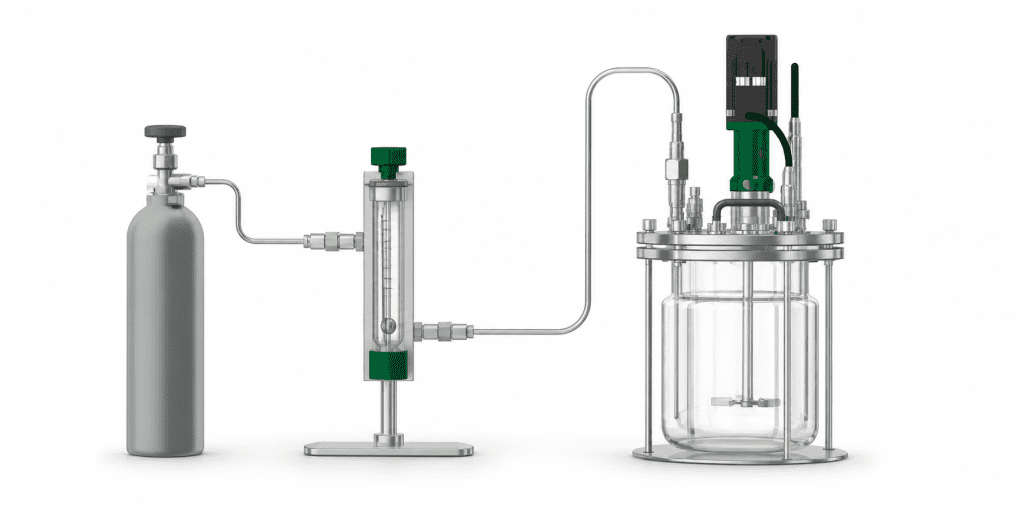
Manual flow adjustment where it is specifically preferred
Rotameters are available when manual flow adjustment is specifically requested or when a simpler, economical gas concept is sufficient. They provide visual flow indication and manual setting.
This can be useful for basic aeration concepts, budget-sensitive configurations or applications where gas flow does not need to change dynamically during the process and full automation is not required.
A simple manual option when visual flow setting is enough.
Custom gas-mix architecture

For special gases and non-standard process requirements
For applications that do not fit a predefined package, the gas architecture can be customized. This includes unusual gas combinations, application-specific gas paths and control logic.
The goal is to build the gas system around the real process requirement. xCUBIO can support anything from simple aeration to highly specific multi-gas strategies integrated into the wider automation and process concept.
Custom gas-mixes support customized processes .
From proven microbial, cell culture and anaerobic gas concepts to MFC-controlled multi-gas architectures, headspace gassing, microspargers, pressure control, optional rotameters and custom gas requirements – xCUBIO gas handling is configured around the process.
Select your impeller concept
Mixing is closely linked to oxygen transfer, heat distribution, suspension behavior and shear stress. xCUBIO benchtop vessels can therefore be equipped with exchangeable impellers, allowing the agitation concept to be selected around the organism and process strategy.
Rushton impeller

For strong radial mixing and gas dispersion
The Rushton impeller is a classic choice for stirred microbial processes to boost gas dispersion, intensity and oxygen transfer.
It is often selected when robust agitation,effective bubble break-up and oxygen-transfer are more relevant than very gentle mixing.
A proven impeller concept for intensive mixing and aeration.
Segment impeller

Adjustable 3-bladed angle for process adaptation
The 3-bladed segment impeller with adjustable angles offers a gentle yet flexible mixing concept for cell culture processes.
The blade angle can be adjusted, allowing the impeller behavior to be tuned for different organisms, media properties or process.
A flexible impeller option when the mixing profile should be adjustable.
Paddle impeller

Gentler mixing with adjustable 2-bladed angle
Paddle impellers are used where a broader, gentler mixing pattern is preferred over highly intensive radial dispersion.
The blade angle can be adjusted, making it possible to adapt the mixing behavior to sensitive cultures or specific suspension needs.
A practical choice for controlled, less aggressive mixing strategies.
Custom impellers

For special process and mixing requirements
Some applications require a mixing concept that does not fit one of the standard impeller types and requires a custom design.
This allows the agitation concept to be matched more closely to unusual media, sensitive organisms or specific processes.
Custom impeller design is available when the standards are no fit.
The impeller is selected together with vessel type, gas entry, agitation range and process objective – so mixing becomes part of the complete bioreactor configuration.
Define your pump and liquid-handling strategy
Liquid handling is a central part of every benchtop bioprocess. Feeding, pH correction, antifoam addition, induction, inoculation, harvest, transfer, circulation and special additions all depend on pumps that match the process – not on a fixed controller package.
Integrated flip-top peristaltic pump heads

Fast tube access for daily laboratory handling
xCUBIO systems are typically equipped with integrated flip-top peristaltic pump heads. This design supports easy tube exchange and convenient daily handling without dismantling the pump head.
In routine lab work, this reduces setup effort and makes it easier to prepare, change or clean media lines between runs. The result is a practical pump-head concept for flexible benchtop operation.
A service-friendly pump-head concept for everyday bioprocess work.
Analog or digital pump control

Continuous speed control or timed on/off operation
Pump drives can be configured as analog or digital versions. Analog pump control changes the actual rotational speed and is therefore the preferred choice when more precise dosing behavior is required.
Digital pump control works by timed on/off operation. For example, a pump set to 50 % runs for 50 % of the time and remains off for 50 % of the time, which can be sufficient for simpler dosing tasks.
The control type is selected according to dosing precision and process task.
Free pump purpose allocation

Assign each pump to the function needed in the run
Each pump can be assigned flexibly in the xCUBIO HMI. This means, a pump is not permanently locked to one predefined function such as acid, base, feed, antifoam, harvest or media addition.
For each run – and even during operation – the user can decide how the available pumps are used. This helps adapt the same system to different organisms, methods, feeding strategies or process phases.
Pump functions follow the workflow instead of a fixed software logic.
Pump functions for bioprocess workflows

Feed, correction, antifoam, induction, harvest and transfer
Integrated pumps can be used for typical bioprocess functions such as acid, base, antifoam, feed, induction, media addition, inoculation, harvest, transfer or process-specific liquid additions.
This flexibility is useful when a process changes between runs, when several feeding strategies are tested, or when a method needs more liquid-handling functions than a fixed benchtop setup provides.
One pump platform can support many liquid-handling and addition strategies.
Integrated Quattroflow process pumps

For gentle circulation, perfusion and process transfer
For process tasks beyond standard peristaltic dosing, xCUBIO can integrate Quattroflow diaphragm pumps directly into the system. They are suited for gentle, low-pulsation handling of sensitive biological liquids.
They can support circulation, perfusion-related workflows, vessel-to-vessel transfer or downstream-oriented process steps. The pump head can be removed and autoclaved with the process system where the sterile concept requires it.
A process-pump option for sterile, gentle liquid handling.
Interfaces for external pumps

For separate pumps and process equipment outside the controller
Where a pump should remain physically separate from the xCUBIO controller, external pump interfaces can be included. This is useful for existing laboratory pumps or larger customer-chosen transfer pumps.
External pumps can be completely integrated into xCUBIO automation and support start/stop functions, speed control, signal exchange or process logic within profiles, sequences and automated workflows.
External pump interfaces connect external pump equipment.
Balance feedback and gravimetric correction

Automatic pump correction based on measured weight
When a balance interface is included, xCUBIO can use measured weight change as feedback for liquid handling. This enables gravimetric feeding, media tracking, harvest monitoring, collection monitoring and mass-based dosing.
For feeding applications, the automation can correct the pump delivery rate based on the actual weight change measured by the balance. This improves dosing accuracy during the run instead of relying only on assumed pump flow.
Gravimetric feedback helps control what was actually dosed.
Pump automation in profiles and sequences

Timed feeding, triggered additions and recurring routines
Pump operation can be included in xCUBIO profiles, sequences and process-control logic. This supports time-dependent feeding, automated additions, process-triggered dosing and recurring liquid-handling routines.
Pump actions can be linked to process values, operator-defined steps or predefined process phases instead of being limited to manual start/stop operation. This makes liquid handling part of the process strategy.
Pump automation turns dosing and feeding into controlled processes.
From integrated dosing pumps to Quattroflow process pumps, external pump interfaces, gravimetric correction and automated feeding logic – xCUBIO liquid handling is configured around the real process workflow.
Define your core sensors and calibration concept
Reliable process control starts with the signals measured directly at the bioreactor. xCUBIO benchtop systems are typically configured with the core process sensors required for controlled cultivation: pH, dissolved oxygen (DO / pO₂), temperature and foam or level detection.
The difference is not only which sensors are connected, but how they are integrated.
pH measurement and control

Core signal for correction and control
pH is one of the central control signals in microbial fermentation, cell culture and many other cultivation processes. It can be used for monitoring and application-specific control strategies.
When CO₂ is part of the gas-mix concept, it can also be used within the pH control loop where appropriate. This connects the pH signal with liquid addition, gas control and process automation.
pH is handled as an active control signal, not only as a displayed value.
Dissolved oxygen measurement

Classical or optical measurement options
Dissolved oxygen can be configured according to application, organism and user preference. xCUBIO benchtop systems can work with classical electrochemical DO / pO2 probes or optical DO / pO2 sensors.
This allows the DO / pO₂ concept to be selected around the process, vessel setup and laboratory practice. The measurement principle does not have to be fixed by the system platform.
DO / pO₂ measurement is selected according to process needs, not only vessel size.
Temperature measurement

Direct vessel measurement with feedback
Temperature is measured directly in the vessel as part of the core process-control concept. This provides the relevant cultivation temperature signal for monitoring, regulation and documentation.
For double-wall vessels, an additional temperature sensor is used within the xCUBIO tempering module. This connects medium temperature and water-based tempering into one controlled thermal system.
Temperature control links the vessel, medium and tempering concept into one process function.
Foam and level detection

Selectable probe lengths and multiple detection points
Foam and level detection are configured according to vessel geometry, working volume and process risk. The interface principle is similar, while the probe length is selected for foam, level or another switching point.
Where the process requires more than one detection point, two or more foam/level interfaces can be integrated. This supports fed-batch operation, different operating volumes, vessel concepts or control actions within one system.
Foam and level detection are adapted to the vessel geometry and process risk.
Sensor-specific calibration

Dedicated calibration logic for each configured device
Each sensor and relevant actuator is supported by a dedicated calibration interface adapted to the device and function. The operator works with a specific interface instead of a generic signal screen.
This becomes important when a system combines different sensor types, actuator functions, measurement principles or application-specific ranges. Calibration remains part of the configured process environment.
Calibration follows the configured device, not a one-size-fits-all interface.
pH recalibration during process

External sample value entered directly into the HMI
pH recalibration during the process is available through the xCUBIO interface. The user can take a sample, measure it with an external pH analyzer and enter the externally measured value into the HMI.
This is useful for longer cultivations where pH measurement can drift or processes where the online pH signal should be checked against an external reference during the run. The measurement can be aligned without stopping the process.
pH can be verified against a real sample and recalibrated during cultivation.
From pH and dissolved oxygen to temperature, foam/level detection and process recalibration – xCUBIO core sensors are configured to support reliable measurement, control and daily operation.
Use balances as active process inputs
Balances can do more than display bottle weight. In xCUBIO benchtop systems, balance interfaces can be used flexibly inside the automation concept for feeding, dosing, media tracking, harvest monitoring, collection monitoring, evaporation tracking or other mass-based process functions.
Flexible balance functions for flexible processes

One interface concept for many tasks
Balance interfaces can be used for different process functions incl. feeding, media bottle tracking, harvest monitoring, collection vessels, weight-loss observation or mass-based additions.
This flexibility makes balances useful beyond one fixed task. The same interface concept can support different workflows when the process, vessel setup or liquid-handling strategy changes between runs and lab demands.
Balances become flexible process inputs, not only weighing accessories.
Gravimetric feeding and dosing

Mass-based control for liquid additions
For feeding and dosing strategies, xCUBIO can use balance feedback to monitor the actual mass change during liquid addition. This supports gravimetric feeding, media addition and mass-based dosing.
Instead of relying only on pump settings or assumed flow rates, the process can use measured weight change as feedback. This improves confidence when dosing accuracy matters for process development or reproducibility.
Liquid additions can be controlled by measured mass, not only pump speed.
Automatic pump delivery correction

Correction based on actual weight change
When balance feedback is used for feeding, xCUBIO can automatically correct the delivery rate based on the measured weight change. The automation compares expected delivery with actual mass change.
This is especially useful when tubing condition, pump behavior, media viscosity or process duration may influence real pump output. The system can compensate during the run instead of assuming constant delivery.
Pump delivery can be corrected from real weighing data during operation.
Selectable balance protocols

Kern, Sartorius, Mettler protocol support
Selected balance protocols from Kern, Sartorius and Mettler can be chosen directly in the xCUBIO HMI without a software change. This allows supported balances to be configured and used flexibly.
Not every balance from these manufacturers uses the same protocol, but additional balance protocols can be added where required. This keeps the xCUBIO system open for customer-preferred balance models and manufacturers.
Balance integration remains adaptable when the weighing hardware changes.
With balance integration, xCUBIO can use real mass change as process feedback – for feeding, dosing, monitoring, correction and documentation across flexible benchtop workflows.
Add off-gas analysis where the process needs it
Off-gas analysis adds a second layer of process information to the bioreactor. Instead of relying only on values measured inside the vessel, the exhaust gas can be used to monitor oxygen consumption, CO₂ formation, metabolic activity and changes in process behavior.
O₂ and CO₂ off-gas monitoring

Use exhaust gas measurement as process information
O₂ and CO₂ are the standard parameters for off-gas analysis in xCUBIO configurations. They help monitor oxygen consumption, CO₂ formation and help to identify changes in biological activity during cultivation.
This is useful when process behavior should be evaluated beyond pH, DO, temperature and feeding data. Off-gas values can support process comparison, optimization and process documentation.
Off-gas analysis turns the exhaust stream into usable process information.
Integrated or external analyzer concept

OEM sensors or interfaces for BlueSens and other systems
Off-gas analysis can be implemented with integrated OEM sensors inside the xCUBIO system concept, or through interfaces for external off-gas analyzers such as BlueSens or systems from other manufacturers.
This allows the analyzer concept to be selected around the system layout, available space, preferred hardware and required integration depth instead of forcing every process into one fixed analyzer setup.
The analyzer concept is configured around the process and system architecture.
Multiplexer operation for twin systems

Structured off-gas analysis for two-vessel setups
For xCUBIO twin systems, integrated off-gas analysis is typically handled in multiplexer operation. This allows more than one vessel to be evaluated through one structured off-gas measuring concept.
This is especially relevant when two independent vessels should be compared, screened or operated with related process strategies, while keeping the analyzer setup compact and integrated.
Multiplexer operation supports off-gas analysis in compact two-vessel workflows.
Application-specific ranges and gases

Configured around expected gas levels
The measuring ranges for O₂ and CO₂ can be selected according to the application. This allows the off-gas concept to be matched to microbial fermentation, cell culture or other process conditions.
Other gases can also be considered on request when the application requires additional gas analysis. The measurement concept should therefore be defined together with the gas-mix strategy.
Off-gas measurement should match expected process behavior and gas composition.
Off-gas values in xCUBIO sequences

Use measured values as automation decisions
Off-gas values can be displayed, recorded, trended and exported as part of the xCUBIO process-data concept. They are available inside the automation environment, not only on a separate analyzer display.
Where configured, these values can also be used as decision values in xCUBIO sequences and recipes. Automated process steps can react to defined O₂, CO₂ or off-gas-related process conditions.
Off-gas signals can become active automation values, not only analytical readings.
OUR, CER and RQ

Calculated indicators as process indicators
Depending on the gas-mix and off-gas configuration, xCUBIO can also use calculated values such as OUR, CER and RQ. These indicators connect gas exchange with metabolic process behavior.
This requires the necessary gas-flow and off-gas signals to be available in the configured system. It should therefore be treated as a process-specific option, not as a generic feature for every setup.
Calculated gas-exchange values can deepen process understanding where supported.
From standard O₂/CO₂ monitoring to integrated OEM sensors, external analyzers, twin multiplexer concepts, sequence decisions and calculated indicators such as OUR, CER and RQ – xCUBIO off-gas analysis is configured around the process question.
Add advanced inline process probes
Some processes require more than the standard signals for pH, dissolved oxygen, temperature and foam or level. xCUBIO benchtop systems can integrate advanced inline probes when biomass development, cell concentration, viable-cell information, dissolved CO₂, substrate concentration or other process-specific signals are relevant.
Inline optical density and turbidity

Biomass-related trends and measurements during cultivation
Inline optical density or turbidity probes can be integrated when biomass development should be followed directly during the process. Examples include suitable technologies from Optek, Hamilton, BugLab or other suppliers.
This is useful for process comparison and development runs where growth trends matter. The signal helps connect biological development with feeding or process timing.
Inline OD and turbidity turn biomass development into a live process signal.
Inline total cell density measurement

Direct information on total cell concentration
Total cell-density probes can provide more specific information about cell concentration than a general OD trend. Technologies such as Hamilton Dencytee can be considered where direct total cell-density information is relevant.
This helps when process decisions depend on cell concentration, not only time or offline samples. The signal can be evaluated by xCUBIO and included in trends, data export or automated workflows.
Total cell density brings cell concentration closer to process control.
Inline viable-cell-density monitoring

Live biomass information for sensitive processes
Viable-cell-density probes can be integrated when information about living biomass is more relevant than total particle, total cell number or turbidity signals. Technologies such as Hamilton Incyte can be integrated for this purpose.
This is especially useful for cell culture and processes where viability, growth phase or living biomass should guide interpretation. The signal helps distinguish useful living biomass from other particles.
Viable-cell monitoring adds biological relevance to inline process data.
Inline dissolved CO₂ measurement

CO₂ insight directly in the liquid phase of the bioreactor
Inline dissolved CO₂ probes can be integrated where CO₂ accumulation or CO₂-related process behavior is important. Technologies from Hamilton, Mettler Toledo or other compatible suppliers can be considered.
This is relevant for cell culture, gas strategy, pH interaction and processes where dissolved CO₂ should be monitored directly in the medium, not only estimated from gas supply or off-gas measurement data.
Dissolved CO₂ measurement adds liquid-phase insight to bioreactor gas control.
In-situ glucose measurement
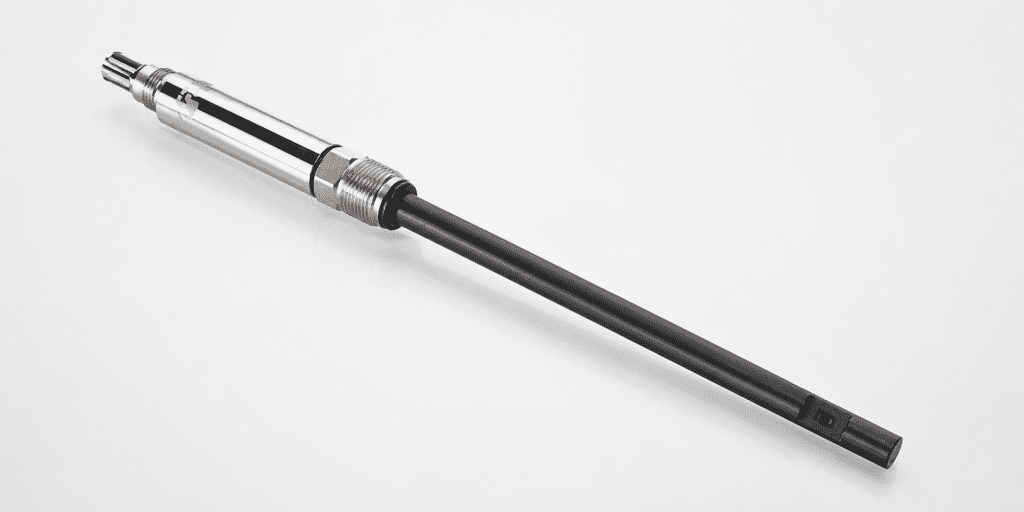
Optical substrate monitoring inside the vessel
For glucose monitoring, an in-situ optical sensor concept can be considered where direct measurement inside the vessel is preferred. Hamilton GlucoSense is one example of this type of glucose sensor technology.
This can support cell culture and substrate-control strategies where glucose trends should be available during the run. The value can become part of the xCUBIO process instead of remaining only an offline result.
In-situ glucose sensing brings substrate information into the live process view.
Bypass glucose and substrate analysis

Enzymatic measurement for glucose and other analytes
As an alternative to in-situ glucose measurement, bypass-based enzymatic sensor concepts can be integrated where the process benefits from external flow-through analysis. IST LV5 is one example of this type of sensor.
Analytes such as glucose, lactate, glutamine or glutamate can be considered. This supports processes where substrate and metabolite trends are relevant to feeding or development decisions.
Bypass analysis can extend xCUBIO with substrate and metabolite insight.
Methanol and special analyte probes

For Pichia processes and application-specific signals
Methanol probes can be integrated where methanol concentration is important to the process, e.g. for Pichia / Komagataella workflows where methanol availability can strongly influence induction and process strategy.
Other special analyte probes can also be considered according to the application. The key question is which additional signal helps control, interpret or optimize the specific cultivation workflow.
Special analyte probes connect process-specific chemistry with automation.
Probe values in xCUBIO automation

Display, record, export and use values in sequences
Advanced probe values are integrated into the xCUBIO process environment. They can be shown in the HMI, recorded in trends, exported with process data and made available to the automation concept.
Where configured, these values can also be used as decision values in sequences. This allows process steps to react to biomass, cell-density, CO₂, glucose, methanol or other probe-based conditions.
Advanced inline probes become active process values, not separate analyzer readings.
From optical density, total cell density and viable-cell-density monitoring to dissolved CO₂, glucose, methanol and special analyte signals – xCUBIO can integrate advanced inline probes directly into the process automation concept.
Connect external signals and devices
Not every relevant process value is measured directly by the bioreactor, and not every device needs to be physically part of the controller. xCUBIO can exchange analog, digital and project-specific communication signals with external equipment, analytical devices and customer-side systems.
This allows external measurements, control signals, device states and defined communication values to become part of the xCUBIO process environment – so the benchtop system can interact with the wider laboratory or automation setup where required.
Analog inputs

Read external measured values into xCUBIO
Analog inputs can bring external measured values into the xCUBIO controller. Typical examples include external off-gas analysis, additional sensors or analog process signals from separate equipment.
The signal can be displayed, recorded and made available inside the configured process environment. This is useful when an important process value is generated outside the vessel but should still be visible in xCUBIO.
External analog values become part of the bioreactor process picture.
Analog outputs

Variable control signals for external equipment
Analog outputs can send variable control signals from xCUBIO to external equipment. Typical examples include external pumps or devices that require a defined setpoint signal instead of simple on/off control.
This allows external hardware like pumps to be included in the process workflow while keeping the relevant control strategy within the xCUBIO automation concept where appropriate.
Analog outputs let xCUBIO control external devices with variable signals.
Digital inputs

Use external status, alarm or trigger signals
Digital inputs can read discrete signals from external equipment and automation systms. Typical examples include status signals, enable signals, limit positions, fault messages, alarms or external triggers.
This allows xCUBIO to react to defined equipment states during operation. A device does not need a complex communication interface to provide useful process or safety-relevant information.
Digital inputs bring external equipment states into the xCUBIO logic.
Digital outputs

Switch external devices, valves, contacts or permissions
Digital outputs can send discrete commands from xCUBIO to external equipment and automation systems. Typical examples include start/stop signals, enable signals, valves, alarm contacts or simple switching functions.
This is useful when external devices like alarms or valves should be part of a process step, sequence or interlock concept without requiring or offering a more complex communication interface.
Digital outputs allow xCUBIO to trigger defined external actions.
Virtual OPC variables

Defined communication values for third-party systems
Virtual OPC variables can be integrated for defined communication with third-party devices or customer-side systems. These variables can represent states, commands, setpoints or process-related values.
This is useful when a project requires more than reading existing controller values and needs a defined exchange between xCUBIO and external equipment or automation environments.
Virtual OPC variables create a project-specific communication layer around xCUBIO.
Custom interfaces

Project-specific integration beyond standard interfaces
Some devices require a project-specific interface instead of simple analog or digital signals. xCUBIO can communicate with selected external equipment using manufacturer protocols where the device and project scope allow it.
This is relevant for analytical devices, pumps, balances, sensors or other laboratory equipment that should exchange defined values with the bioreactor automation instead of remaining isolated.
Custom interfaces help connect specialized equipment to the xCUBIO process environment.
From analog measurements and external control signals to digital status logic, virtual OPC variables and project-specific manufacturer interfaces – xCUBIO can connect benchtop bioreactors with the wider process environment.
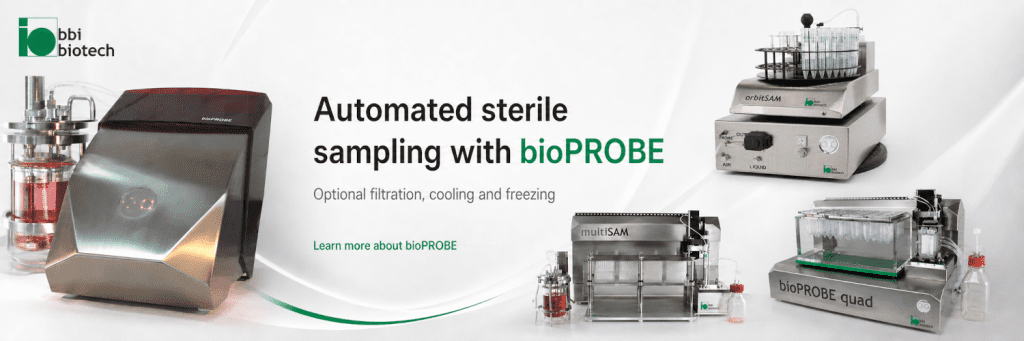
Automated sterile sampling with bioPROBE
When recurring samples, defined sampling times or reduced manual intervention matter, xCUBIO benchtop systems can be planned with bioPROBE automated sterile sampling.
Why choose xCUBIO twin instead of two separate systems?
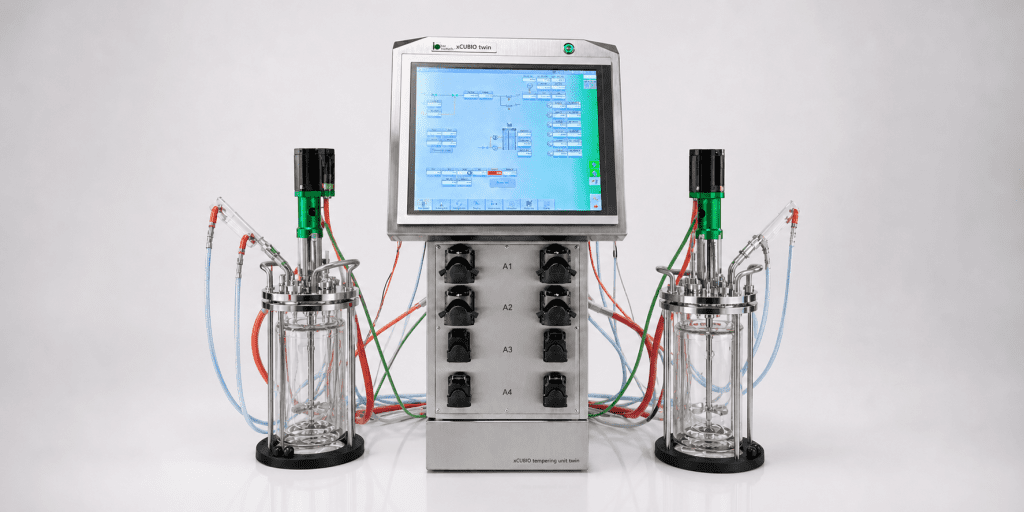
When two benchtop vessels are required, the best solution is not always two fully separate bioreactor systems. xCUBIO twin provides two independently configured and operated vessels within one compact xCUBIO platform.
Compact two-vessel architecture

Two vessels in one benchtop platform
xCUBIO twin combines two vessel positions in one compact benchtop system. Instead of placing two separate controller platforms side by side, both vessels are operated within one integrated xCUBIO twin.
This reduces bench space and duplicated hardware when the two vessels are used in the same laboratory workflow. The setup remains compact without turning the vessels into one shared process.
Two independent vessels can be operated side by side without duplicating the full system footprint.
Independent operation of each vessel

Separate process control for left and right side
Each vessel in an xCUBIO twin system can be operated independently. Setpoints, control loops, profiles, sequences, feeds, sensor values and process data can be handled separately for the left and right vessel.
This matters when two runs should follow different strategies, when one vessel acts as reference, or when process conditions need to be compared under controlled and documented operating conditions.
xCUBIO twin provides two separate process environments within one operating platform.
Independent configuration
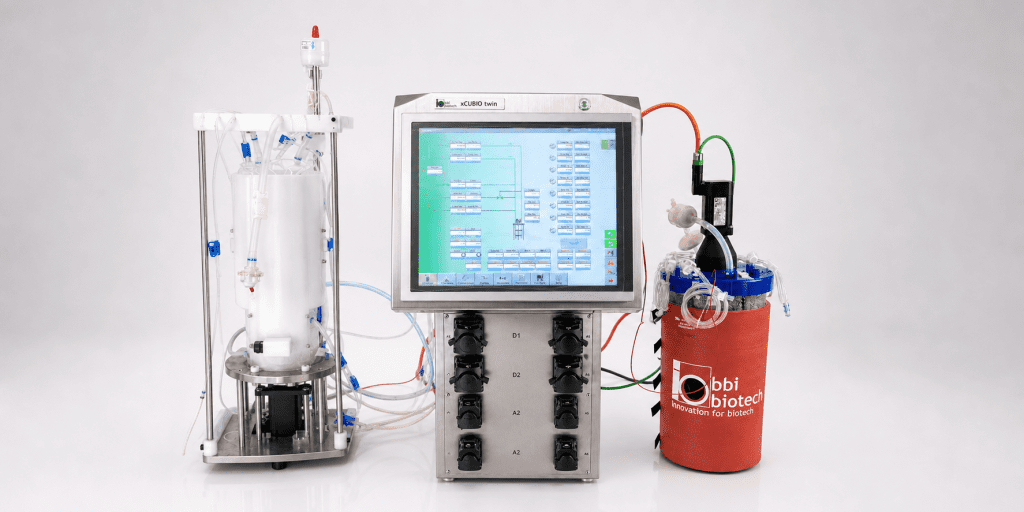
Components selected according to each vessel
The two sides of an xCUBIO twin system do not have to be identical. Vessel-related components, pump capacity, gas handling, sensors and process options can be selected according to the requirements of each side.
Many twin systems are configured symmetrically for comparison work. When the application requires it, the left and right vessel can also support different setups, functions or process strategies.
Twin does not mean two fixed copies – it means two configurable vessel positions in one system.
More efficient than two xCUBIO single systems

Less duplicated hardware, one operating concept
When two vessels are needed for one connected workflow, xCUBIO twin is usually more cost-efficient than two separate xCUBIO single systems. It avoids duplicating the complete controller platform.
The user also works within one consistent xCUBIO environment instead of managing two independent systems. This can simplify operation, training, documentation and daily laboratory handling.
For many two-vessel workflows, xCUBIO twin is the more efficient system architecture.
Made for Scale-in-One and process scale-up testing

Two related process stages in one setup for Scale-Up studies
xCUBIO twin can support Scale-in-One workflows when two related process stages or vessel sizes should be operated in one compact system. This can be relevant for seed/production logic or connected development.
The advantage is not only that two vessels are available, but that both vessels can be used in one workflow. Different vessel sizes, strategies or process stages can be combined where useful.
Scale-in-One turns xCUBIO twin into more than a two-vessel comparison system.
When two single systems are still better than a twin
For maximum physical or operational separation
Two separate xCUBIO single systems can still be the better choice when the vessels must be used in different rooms, by different teams, or in workflows requiring maximum physical and operational separation.
They can also make sense when the two processes are unrelated, when independent availability is critical, or when each vessel should remain a fully separate system over its lifetime..
xCUBIO twin is strongest when two vessels belong to one connected benchtop workflow.
Choose xCUBIO twin when two independent vessels should work side by side in one compact, cost-efficient xCUBIO platform. Choose two xCUBIO single systems when complete physical separation is more important than shared architecture.
Scale-in-One with xCUBIO twin
Scale-in-One is a two-stage benchtop workflow concept for xCUBIO twin. One vessel can be configured as a seed stage, while the second vessel is configured as a larger production-like main culture within the same xCUBIO system.
At a defined process point, xCUBIO can trigger the transfer from the seed vessel to the main vessel by sequence-controlled pumping. The trigger can be based on time or on process signals such as torque, optical density or other configured values.
Seed and main culture vessels in one setup

Two connected process stages in one system
xCUBIO twin can be configured with one vessel for seed cultivation and one vessel for the production-like main culture. This creates a connected two-stage workflow within one compact benchtop system.
This is useful when inoculum or seed preparation and the next process stage should be planned and developed together instead of being treated as completely separate laboratory operations.
Scale-in-One connects seed and main culture work in one xCUBIO twin setup.
Different vessel sizes for different use cases

Small seed vessel, larger main vessel
Scale-in-One is especially relevant when the two sides of the xCUBIO twin use different vessel sizes. A smaller vessel can support seed cultivation, while a larger vessel can represent the next process stage.
This allows teams to work with a practical size relationship inside one benchtop platform. The goal is not only to run two vessels, but to create a meaningful process connection between them.
Different vessel sizes make xCUBIO twin a true two-stage benchtop workflow.
Sequence-controlled transfer between vessels
Pump transfer at a defined process point
The transfer from seed vessel to main vessel can be handled by an integrated pump within an xCUBIO sequence. The transfer step can be started at a defined time or according to configured process conditions.
This is valuable when the inoculation point should be reproducible and linked to real process behavior. Signals such as torque, optical density or other process values can be used where configured.
Sequence-controlled transfer makes the stage change reproducible and documented.
Closed sterile transfer concept with pressure or pumps

Designed around controlled transfer
The vessel-to-vessel transfer can be configured as a closed sterile transfer concept where the process requires it. Transfer lines, pump function and sequence logic are planned as part of the xCUBIO twin configuration.
This helps reduce manual handling during the stage change and supports a more controlled transition from seed cultivation to the production-like main culture in the second vessel.
Closed transfer turns inoculation into a planned process step, not a manual workaround.
One automation concept for both stages

Separate control, connected workflow
Both vessels remain independently controlled even when they are part of one Scale-in-One workflow. Setpoints, profiles, feeds, sequences, sensor values and data can be handled separately for each side.
At the same time, xCUBIO can connect both stages through defined sequence logic. This gives process developers separate control where needed and coordinated automation where the workflow benefits from it.
Scale-in-One combines independent vessel control with coordinated process logic.
When Scale-in-One is not the right fit for your process

For true scale-up or fully separated workflows
Scale-in-One is a benchtop workflow concept, not a replacement for pilot-scale or production-scale scale-up. It is strongest when two related early process stages should be developed in one compact system.
If the next step requires SIP-capable stainless-steel pilot equipment, much larger working volumes or complete physical separation, a different xCUBIO system concept may be more appropriate.
Scale-in-One is best for connected benchtop stages, not for replacing real scale-up.
Use Scale-in-One when seed cultivation, vessel-to-vessel transfer and a production-like main culture should be developed as one connected benchtop workflow — with independent control on both sides and coordinated xCUBIO sequence logic between them.
Application fit: Configure xCUBIO around the process
xCUBIO benchtop systems can be configured for standard microbial and cell-culture workflows, but also for more demanding or less conventional applications. The relevant setup depends on the organism, vessel concept, gas strategy, feeding approach, sensor package, sampling needs and automation depth.

Microbial cultivation
For aerobic bacterial processes, fed-batch strategies, DO control, pH correction, foam handling and defined gas supply.

Mammalian cell cultivation
For controlled cell-culture workflows with CO₂, gentle mixing, optical DO, dissolved CO₂, glucose and viable-cell-density options.

Insect cell cultivation
For cell-culture-style processes with adapted mixing, gas control, temperature strategy and monitoring requirements.

Anaerobic cultivation
For anerobic workflows requiring oxygen exclusion, N₂-based gas strategies, redox monitoring or defined low-oxygen conditions.

Fungal
cultivation
For fungal processes where morphology, viscosity, pellet formation or mycelial growth influence mixing and vessel geometry.

Phototrophic cultivation
For phototrophic experiments or algae-related workflows where light and vessel concept need to be considered together.

Carrier-based cultivation
For applications involving surfaces, carriers or attachment-based growth where geometry and sampling needs adaptation.

Perfusion-like cultivation
For continuous additions, balance-supported feeding, harvest/bleed concepts and sequence-controlled liquid handling.

High-cell-density cultivation
For processes with high oxygen demand, strong feeding requirements, foam risk, heat load or increased monitoring needs.

Pichia
cultivation
For methanol-related workflows, high oxygen demand, feeding strategies, foam control and off-gas-based process insight.

Substrate-based cultivation
For workflows where methanol, glucose or other substrates should be monitored or controlled as part of the process strategy.

Off-gas-driven cultivation
For applications where O₂, CO₂, OUR, CER or RQ help interpret metabolism, feeding, induction or process transitions.

High-solid
cultivation
For applications that do not behave like standard stirred liquid cultures and may require adapted vessels, impellers or outlets.

Komagataella cultivation
For methanol-related workflows, high oxygen demand, feeding strategies, foam control and off-gas-based process insight.

Academic R&D and training
For universities and research groups that need real bioreactor functionality, flexible setups and expandable configurations.
xCUBIO benchtop systems can be configured for standard microbial and cell-culture workflows, but also for more demanding or less conventional applications. The relevant setup depends on the organism, vessel concept, gas strategy, feeding approach, sensor package, sampling needs and automation depth.
Automation & Control with xCUBIO – one consistent automation platform across all reactor types and scales
xCUBIO brings structured operation, advanced process logic and flexible integration into one coherent automation environment across bbi-biotech bioreactor systems. From benchtop and parallel glass systems to SIP-capable stainless-steel pilot and production bioreactors, users work with one consistent automation philosophy instead of fragmented controller generations.
The result is a shared control logic for process development, scale-up, production and retrofit projects – supporting familiar operation, scalable process logic and flexible integration across reactor types and vessel concepts.


One platform across systems and scales
xCUBIO provides one consistent automation platform across different bioreactor types, process concepts and development stages.
Instead of forcing users to adapt to different controller logics as systems grow more complex, it creates a shared operating structure that supports comparability, faster familiarization, cleaner transfer of process logic and a more coherent path from early development to larger-scale operation.

Premium automation beyond conventional controller logic
A serious bioreactor controller must provide clear overview screens, reliable control loops and direct manual access where needed. xCUBIO does all of that as a matter of course – but its real strength lies far beyond conventional controller logic.
The platform combines real-time process visualization, integrated alarm handling, manual actuator access, profile functions, advanced sequences, data recording and export within one structured operating environment designed for significantly greater depth, flexibility and process control than a conventional controller typically offers.

Profiles, Sequence Editor & Valve Editor
This is where xCUBIO becomes especially powerful. Time-dependent profiles allow process values and actuator outputs to follow defined progressions instead of remaining static.
The graphical Sequence Editor and Valve Editor enable users to automate recurring process steps and genuinely process-driven routines without conventional programming including complex valve-position logic and valve state changes.
Together, these tools bring an unusual level of automation freedom to the user: powerful process logic without the need to build custom software for every advanced routine.

Built for flexible process architecture and connectivity
xCUBIO is designed for processes that do not fit into rigid standard architectures. Additional sensor technology, external devices and analytical signals can be integrated with exceptional flexibility, while pumps and other functions can be assigned in ways that reflect the real needs of the process rather than a predefined package logic.
At the same time, trend recording, CSV export, remote access via integrated VNC functionality and OPC connectivity support structured data use, system integration and future-ready automation concepts.

Automation
Sequence Editor
Valve Editor
Complex Recipes

Flexibility
Sensor Choice
Gas-mix Concepts
Control Possibilities

Visualization
19″ touchscreen
Trend displays
Live Visualization

Connectivity
Remote Access
OPC Interfaces
Export Features

Tell us about your benchtop bioreactor project
Whether you are planning a focused single-vessel setup, comparing xCUBIO single and xCUBIO twin, selecting vessel size and temperature-control concept, or preparing a defined benchtop bioreactor request, we will help route your enquiry to the right team and next step.

I want to discuss my application
For early project discussions, process requirements, vessel selection, automation options, scale-up paths and technical feasibility questions.
I need a bioreactor quote
For defined system requests, planned purchases, quotation preparation or projects where required options are already reasonably clear.
I need service or spare parts
For running systems, service cases, complete vessel and spare parts needs, or selected upgrade or hardware requests and questions.
Direct contact to Berlin head office
+49 (0)30 221 800 10
info@bbi-biotech.com
bbi-biotech GmbH
Landsberger Str. 259
12623 Berlin