
Turn bioreactor sampling into a controlled workflow
Automate sterile sample withdrawal, define sampling routines and connect your bioreactor to structured sample handling – from simple collection to filtration, cooling, freezing and analytics-oriented workflows.

Higher sampling resolution

Reduced manual workload

Sterile-by-design withdrawal

Configurable sample handling

Patented sterile sampling technology for glass, stainless-steel, single-use, autoclavable and in-situ bioreactor systems.
Four reasons to automate bioreactor sampling
Automated sampling becomes valuable when sampling is no longer an occasional manual step, but a repeated process requirement. bioPROBE helps bioprocess teams define when samples are taken, protect how they are withdrawn and control what happens to them after leaving the reactor.
Higher sampling resolution

Better process understanding and more reliable development decisions.
Sparse manual samples can miss relevant process dynamics between two sampling points. bioPROBE enables more frequent, scheduled sample withdrawal, helping teams capture a higher-resolution view of offline parameters during critical process phases.
Reduced manual workload

Less routine work and more predictable use of laboratory resources.
Manual sampling interrupts operators, binds trained staff and becomes difficult during nights, weekends or long cultivations. bioPROBE automates repeated sampling routines, reducing dependency on constant manual intervention at the reactor.
Sterile-by-design

Safer sampling workflows for sensitive bioprocess applications.
Every sampling step must protect the bioreactor and the sample. bioPROBE is designed around sterile sample withdrawal, defined transfer paths and application-specific handling concepts to reduce contamination-related process risks.
Configurable handling

A structured path from reactor sampling to usable process information.
The value of sampling does not end at withdrawal. Depending on configuration, bioPROBE can connect sample collection with filtration, cooled storage, frozen storage or analytics-oriented workflows after the sample leaves the reactor.
Reveal process dynamics that manual sampling can miss
Manual sampling often provides only a small number of selected data points. That can be enough for basic checks, but it may hide relevant changes between two sampling events. With bioPROBE, samples can be taken more frequently and at defined times. This helps process teams capture a more detailed view of the same bioprocess – especially during fast-changing, critical or poorly understood process phases.

Automated sterile sampling increases the time resolution of offline process data, helping teams understand what happens between individual manual samples.
When sampling becomes frequent, scheduled or parallel, the real cost is the repeated manual work behind every sample.
Manual sampling starts simple, but every additional sample adds operator time, reactor access, handling and documentation. bioPROBE requires an initial setup, but once the workflow is defined, each further sample can be taken with much lower recurring effort.

Frequent sampling

The more samples a process requires, the more manual sampling turns into repeated routine work.
Defined sampling times

Samples may be needed at process-relevant moments, not only when an operator is available.
Night and weekend runs

Automated routines can reduce manual sampling pressure outside normal working hours and unattended process phases.
Parallel bioreactors

Synchronized sampling across several reactor lines becomes difficult to maintain manually over long runs.
From repeated manual intervention to a controlled sampling workflow
Manual sampling is not only the moment of taking a sample. It includes timing, reactor access, handling, transfer, documentation and follow-up steps – every time a sample is required. With bioPROBE, sampling can become a defined workflow: samples are withdrawn at planned times, transferred through a controlled path and routed into the configured handling steps after leaving the reactor.
Manual sampling

Operator-dependent timing
Samples are taken when trained staff are available, not always when the process reaches the most relevant phase.
Few individual data points
Manual routines often limit the number of samples, especially during long runs, nights, weekends or parallel experiments.
Repeated manual intervention
Every sample requires reactor access, preparation, handling, transfer and documentation as a separate manual task.
Manual follow-up steps
Collection, filtration, cooling, freezing or transfer to analytics often happen as additional disconnected steps after sampling.
Higher risk of timing drift
Sampling times can shift between operators, shifts, reactors or campaigns, reducing comparability between runs.
Difficult parallel coordination
Keeping several reactor lines synchronized manually becomes harder as sampling frequency and process duration increase.
Sampling with bioPROBE

Defined sampling routines
Samples can be taken according to planned routines, helping teams collect data at process-relevant moments.
Higher offline data resolution
More frequent sampling can reveal process dynamics that sparse manual samples may miss.
Automated sterile withdrawal and transfer
Sampling is moved from repeated manual handling to a controlled withdrawal and transfer workflow.
Configurable sample handling
Samples can be routed into collection, filtration, cooling, freezing or analytics-oriented workflows depending on configuration.
More repeatable workflows
Defined routines help reduce operator-dependent variation between runs, shifts and repeated campaigns.
Better synchronization across reactor lines
Parallel sampling workflows can be aligned more consistently across multiple bioreactors.
This is the central shift: bioPROBE does not only automate the act of taking a sample – it helps define the complete sampling workflow around the process.
A sterile sampling platform for bioprocesses where timing, reproducibility and sample handling matter
bioPROBE is an automated sterile sampling technology for bioreactors. It combines a dedicated sampling probe, controlled sample withdrawal and configurable sample handling for workflows where manual sampling becomes too limited or too inconsistent.
bioPROBE is designed to withdraw samples from a defined position in the bioreactor and transfer them through a controlled path into the selected sample-handling setup.
Depending on configuration, this can mean direct collection, filtration after withdrawal, cooled or frozen storage, or preparation for analytics-oriented workflows.
It becomes especially valuable when samples are needed frequently, at defined process times, across parallel reactors or in workflows where sterility, reproducibility and downstream handling are critical.

bioPROBE is not simply an autosampler. It is the sampling interface between the bioreactor and a defined sample-handling workflow.
One sampling technology, configured for simple collection or advanced parallel sample handling
bioPROBE can be configured as a straightforward single-reactor sampling solution or as an advanced platform for up to four reactor lines. The right path depends on reactor count, sampling frequency and what needs to happen to the sample after withdrawal.
bioPROBE single + orbitSAM – For one bioreactor or one sampling line

bioPROBE single with orbitSAM is the practical entry into automated sterile sampling. It is designed for laboratories that need defined sampling times, reduced manual intervention and straightforward automated sample collection from one reactor line.
Best for
- One bioreactor
- Scheduled sampling routines
- Reduced manual sampling workload
- Automated sample collection
- Night, weekend or unattended sampling phases
- Entry-level automated sterile sampling
bioPROBE quad + multiSAM + iceBLOCK – For parallel workflows and advanced sample handling

bioPROBE quad with multiSAM and iceBLOCK is the advanced path for up to four reactor lines. It supports separated fluid paths, structured sample handling, filtration and temperature-controlled storage where required by the process.
Best for
- Up to four bioreactors
- Parallel process development
- Synchronized sampling routines
- Separated reactor fluid paths
- Filtration after withdrawal
- Cooled or frozen sample storage
Both configurations are based on the same bioPROBE sampling principle. The difference is the workflow around it: one reactor with straightforward collection, or multiple reactor lines with advanced sample handling.
How bioPROBE protects the reactor during sampling
bioPROBE protects the reactor through a simple but powerful principle: the probe is either safely closed and pressure-monitored, or opened only while the sample is drawn – ensuring the sterility at all times.
Closed and monitored
In the resting state, positive pressure keeps the valve at the tip of the probe closed.

The bioPROBE main device continuously monitors the pressure, ensuring that the reactor remains isolated from the outside while no sample is being taken.
Open only under negative pressure
Before the probe opens, the transfer path is prepared under negative pressure.

The valve in the tip of the bioPROBE probe only opens under negative pressure – this ensures by design the sterility of the bioreactor.
Full transfer after closure
Once the defined sample has entered the tubing, the bioPROBE probe closes again.

Sterile air then pushes the sample onward toward collection or the configured sample-handling workflow and cleans the sampling line.
Originally patented by the Max Planck Institute, exclusively licensed and brought to market by bbi-biotech.

From reactor withdrawal to sample result: a defined workflow for every sample
The value of automated sampling does not end at withdrawal. With bioPROBE, each sample can move through a defined workflow from the bioreactor to collection, optional filtration, temperature-controlled storage or analytics-oriented preparation.
The workflow can be simple or advanced. In a single-reactor setup, the main goal may be scheduled sterile collection. In a multi-reactor setup, the same sampling principle can be extended into separated fluid paths, filtration, cooled or frozen storage and analyzer-oriented workflows.

bioPROBE is designed to connect the sampling point in the bioreactor with the required sample-handling workflow. After the sample has been withdrawn safely and the reactor is isolated again, the sample can be transferred toward the configured destination – from simple collection in sample vessels to more advanced workflows with filtration, cooling, freezing or analytical preparation.
Superior by design: why bioPROBE is different from conventional sampling methods
Conventional sampling methods can take a sample – but the sampling concept determines how representative, sterile and reproducible that sample can be. bioPROBE is designed around controlled reactor withdrawal, separated fluid paths and configurable sample handling after the sample leaves the bioreactor.
No operator-dependent process snapshots

More reproducible sampling routines with less manual dependency.
Manual sampling depends on operator availability, shift schedules, reactor access and repeated handling steps. During long cultivations, night runs or parallel experiments, this can create variation between samples, operators and campaigns.
bioPROBE turns sampling into a defined routine with automated withdrawal and configurable sample handling. This helps make sampling less dependent on who is available at a specific time.
No needle handling and hazardous intervention
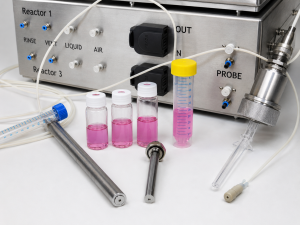
Less manual bioreactor access and reduced needle-handling and safety risks.
Sampling through an injection septum or puncture membrane may look simple, but every sample requires a manual action at the reactor. Each intervention depends on operator technique, aseptic handling and correct timing.
It also introduces practical needle-handling hazards for the operator. For frequent or scheduled sampling, bioPROBE replaces repeated punctures and needle handling with a controlled automated workflow.
No filter or membrane inside the bioreactor

Representative withdrawal without a permanent filter inside the reactor.
Concepts that use filtration probes place a filter surface or membrane directly in the reactor environment. During longer or more demanding processes, this can create risks such as biofilm formation, fouling or blocked filters.
With bioPROBE, the sample always leaves the reactor before optional filtration takes place. A representative, cell-containing sample is taken that is processed in later steps without risk of cross-contamination.
Cell-containing samples before optional filtration

Flexible sample strategies without forcing filtration into the reactor.
Filtration-based sampling concepts often define the sample type directly at the reactor interface. This can limit flexibility when both cell-containing and cell-free sample strategies are relevant within the same process.
With bioPROBE, the sample can first be withdrawn cell-containing from the reactor. If cell-free samples are required, filtration can be configured downstream – with one sample, one filter.
No sampling from stationary harvest-pipe liquid

Reduced risk of sampling medium changed by pipe hold-up.
Harvest and transfer pipes can contain medium that is not under the same conditions as the reactor volume. Liquid may stand in the pipe and experience different aeration, residence time or local substrate conditions.
bioPROBE is designed to withdraw from a defined sampling position inside the bioreactor. The sample originates from the reactor volume, not from stationary liquid in a harvest or transfer pipe.
No distortion from harvest-line flow conditions

Less distortion from line flow and previous liquid.
Sampling from a harvest or transfer line can be influenced by the line geometry and flow profile. Laminar flow, non-uniform liquid fractions or previous liquid in the line can affect what is actually sampled and distort analytical results.
bioPROBE separates sampling from the harvest or transfer path. The sample is taken through the dedicated sampling interface before it is transferred onward through the tubing set for defined handling.
No unnecessary dilution by cleaning-fluid strategies

Cleaner sample handling for small volumes
Some sampling concepts rely on cleaning or flushing fluids that can dilute small samples or make interpretation more difficult. This becomes especially relevant when sample volume is limited or analytical sensitivity matters.
The standard bioPROBE workflow avoids cleaning-fluid dilution by using sterile-air transfer and, where required, a defined pre-sample strategy before the final sample is collected.
Separated fluid paths up to sample storage

Parallel sampling without crossing reactor fluid paths
In parallel bioreactor workflows, shared sample paths can create carry-over or cross-contamination concerns. bioPROBE quad is built around completely separated fluid paths for up to four reactor lines – no switch valves or crossed lines.
The complete fluid path is formed by the probe and tubing set. Inside the bioPROBE unit, the tubing is actuated by pinch valves and pump elements, but the sample does not enter shared internal wetted channels.
The advantage is not only automation – it is a sampling architecture designed for sterile, representative and reproducible bioprocess workflows.
The sample workflow does not end at withdrawal
After the sample has left the reactor, bioPROBE can route it into the handling strategy required by the process – from simple collection to filtration, cooling, freezing or analytics-oriented preparation. This makes sampling more than a withdrawal event: each sample can follow a defined path according to the process, the analytical method and the required handling conditions.
Collect
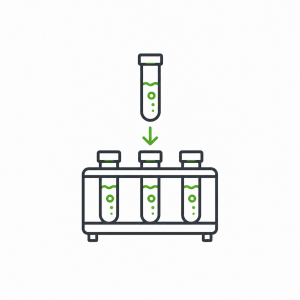
Collect samples into defined vessels, racks or formats according to the selected configuration.
This supports scheduled offline sampling without repeated manual withdrawal, distribution and handling at every step.
Defined collection in standard vials for routine offline analysis.
Filter

Generate cell-free samples after reactor withdrawal, without placing a permanent filter surface inside the bioreactor.
Filtration remains a downstream handling step, so the reactor-side sampling interface stays unclogged.
Clarified samples without an in-reactor filter.
Cool

Route temperature-sensitive samples into cooled handling concepts to bridge the time between sampling and analysis.
This is especially relevant during night runs, weekend sampling or delayed analytical processing.
Better support for time-sensitive samples.
Freeze

Where configured, freeze samples for later or batch-wise analysis.
This can help preserve automatically collected samples when analysis does not happen immediately after withdrawal.
Preserved frozen samples for delayed analytics.
Prepare

Prepare samples for later analytics before measurement.
This helps turn collected samples into more useful and more automated input for offline and atline analytical devices and workflows.
More structured samples before analysis.
The key shift: bioPROBE does not only automate withdrawal – it also helps define what happens to the sample after it leaves the reactor.
From withdrawn sample to analysis-ready workflow – and toward connected atline process environments
bioPROBE does not stop at sterile sample withdrawal. After the sample leaves the bioreactor, the workflow can be configured for defined collection, optional filtration, cooling, freezing and preparation for downstream analysis. Together with xCUBIO process automation, bioPROBE gives bbi-biotech two key technology elements for connecting bioreactor operation, sample handling and atline-oriented process environments.

Sterile withdrawal from the bioreactor
A more reliable starting point for every sample.
The workflow begins with defined sterile withdrawal from the bioreactor through the bioPROBE sampling interface. This creates a controlled starting point for downstream sample handling instead of relying on repeated manual reactor access at every sampling event.
Configured handling after sample withdrawal
The sample route can be designed around the process.
After withdrawal, the sample can be routed into the required handling strategy. Depending on the configuration, this may include direct collection, downstream filtration, cooling, freezing or preparation for the next analytical step.
Prepared for atline analytical workflows
Better alignment between sampling and analytics
Many analytical methods require more than a sample in a tube. Samples may need defined timing, volume, filtration, cooling, freezing or preparation before they become useful input for offline or atline analysis.
Ready for feedback into process automation
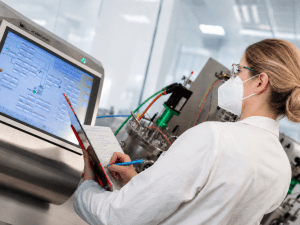
A practical foundation for more data-driven process decisions.
Analytical results can be linked back into process control via xCUBIO. This is where bbi-biotech’s combined strength becomes strategically relevant: automated bioreactor control and sterile sampling can be connected within one broader process environment.
bioPROBE automated sampling devices and xCUBIO bioreactors are 2 building blocks for a true PAT worklflow.
Automation & Access – Built-in interfaces for stand-alone, xCUBIO and OPC UA sampling control
bioPROBE is built as an automation-ready sampling system with its own real-time controller, browser-based web interface and OPC UA server. Sampling can be operated directly, triggered from xCUBIO process automation or coordinated from higher-level SCADA systems while the detailed sampling logic remains configured in bioPROBE.
Direct operation through the bioPROBE web interface
bioPROBE can be configured and operated directly through its browser-based interface, without installing dedicated local software.
This gives laboratories a practical way to define sampling routines, start custom samples and adjust configurations directly at the sampling system.
The interface supports scheduled sampling cycles, custom samples, sample volume settings, connected autosampler control and cleaning method configurations.
- Scheduled sampling routines
- Custom samples when required
- Sample volume configuration
- Cleaning method configuration
- CSV export
No need for additional software

Process-triggered sampling from xCUBIO automation
When bioPROBE is used with xCUBIO, sampling can be triggered directly from the bioreactor automation.
This allows sample events to be linked to process sequences, batch phases or defined process conditions instead of remaining a separate manual action.
xCUBIO can start an individual sample, start a predefined sampling program and provide the sample volume – all based on internal parameters and sequence steps.
- Sampling triggered from xCUBIO sequences
- Sampling linked to process phases or process conditions
- Start of individual samples or sampling program via xCUBIO
- Native bioreactor control of sampling
Sampling directly integrated in bioreactor control

OPC UA access for higher-level SCADA systems
bioPROBE includes its own OPC UA server for integration into higher-level automation environments.
This allows external SCADA or plant automation systems to coordinate sampling through defined interface commands where this is part of the project scope.
Via OPC UA, a higher-level system can start an individual sample, start a predefined sampling program and provide the sample volume based on SCADA level decisions.
- OPC UA access
- External sample start
- External time program start
- Sample volume calibration
- SCADA-level coordination of sampling
Direct OPC UA access

The key advantage is architectural: bioPROBE is not only a sampling device, but an automation module for sterile sampling routines, process-triggered samples and SCADA-coordinated workflows.

Where automated sterile sampling creates the strongest process value
bioPROBE is most valuable when sampling is no longer an occasional manual action, but a recurring part of process development, parallel comparison, long cultivations or analytics-oriented workflows. Different teams benefit in different ways – depending on how often samples are needed, how critical timing is and what must happen to each sample after withdrawal.
Process development

Comparable time points across development runs
In process development, sampling is not only about collecting data. It is about collecting data at comparable moments, especially when different runs, feeding strategies, organisms or process conditions are being evaluated.
bioPROBE helps reduce timing drift by turning sampling into a defined routine. More frequent and better aligned offline samples can make process dynamics easier to compare across campaigns, reactors and development phases.
Value: Better comparability and higher-resolution process understanding.
Parallel bioreactor users

Synchronized sampling across parallel reactor lines
Parallel bioreactor work becomes difficult when sampling times, handling steps or operator availability differ between reactor lines. Even small deviations can make comparative experiments harder to interpret.
bioPROBE quad supports structured sampling from up to four reactor lines with separated fluid paths. This helps teams align time points and handling logic across parallel workflows while reducing repeated manual intervention.
Value: More consistent sampling across parallel experiments.
Microbial fermentation

High-frequency sampling during fast fermentations
Microbial fermentations can change quickly, especially during feeding phases, oxygen limitation, substrate transitions or high-cell-density processes. Manual sampling can become a bottleneck when frequent data points are needed.
bioPROBE helps automate sterile sample withdrawal during dynamic process phases, including scheduled or additional samples when required. This supports closer monitoring without constant manual access to the reactor.
Value: More process insight during fast-changing fermentation phases.
Cell culture

Sterile routines for sensitive long-running cultures
Cell culture processes often run longer and can be sensitive to repeated manual intervention. Sampling must support sterility, reproducibility and careful handling without adding unnecessary disturbance to the workflow.
bioPROBE enables defined sterile withdrawal routines for sensitive cultures. Samples can be taken reproducibly and transferred into the configured handling workflow while reducing the need for repeated manual reactor access.
Value: Repeatable sterile sampling for sensitive cultivation workflows.
Analytics and PAT-oriented teams
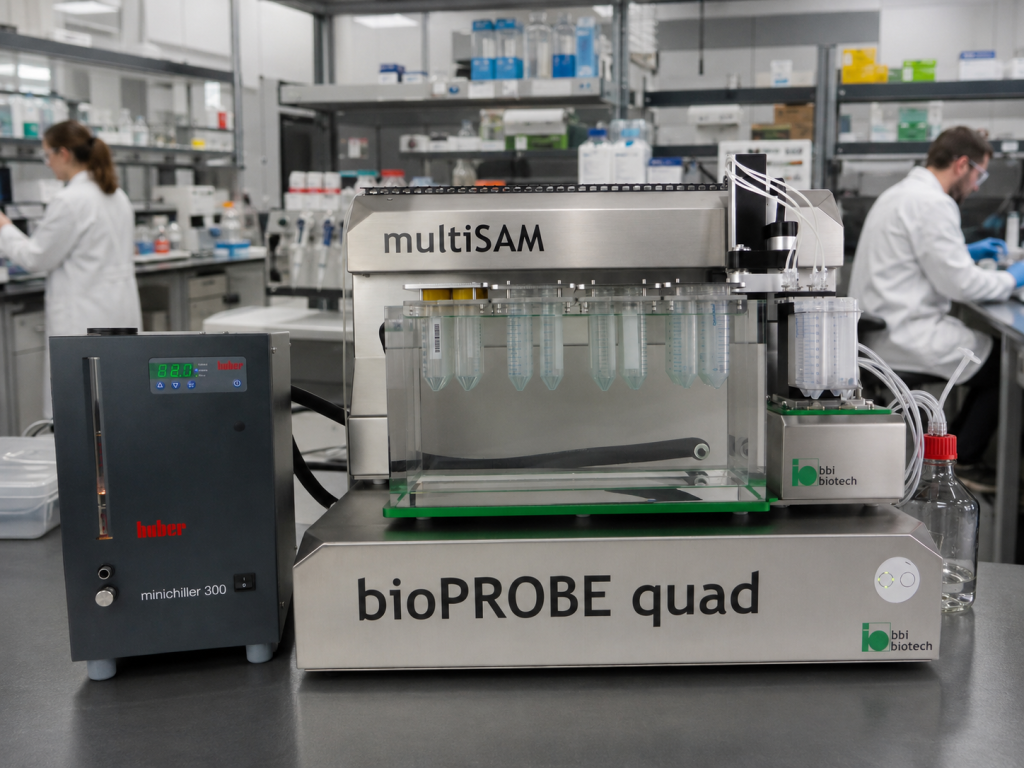
Structured samples for analytics-oriented workflows
Analytics teams need more than a sample in a tube. Depending on the method, samples may need defined timing, filtration, cooling, freezing or preparation for atline and PAT-oriented workflows – and reliable interpretation.
bioPROBE connects sterile withdrawal with configurable sample handling after the sample leaves the reactor. This can help create a more structured path from offline sampling toward analytics-ready process information.
Value: Better prepared samples for analytical workflows.
Lab management and operations

Lower staffing pressure during repeated campaigns
Long runs, night phases, weekend sampling and repeated campaigns can turn manual sampling into a staffing problem. The challenge is not one sample – it is the accumulated routine effort around every sample.
bioPROBE helps move recurring sampling tasks into defined automated routines. This can reduce operator dependency, make sampling schedules easier to plan and support more consistent execution across campaigns.
Value: Less manual workload and more predictable sampling operations.
The common benefit is control: sampling becomes more reproducible, better timed and easier to integrate into real bioprocess workflows.
Reusable and single-use probe concepts for automated sterile sampling
bioPROBE can be configured with reusable stainless-steel probes or pre-assembled single-use probe sets. Both probe concepts can be evaluated for glass, stainless-steel and suitable single-use bioreactor setups – depending on preparation effort, validation strategy, product-contact documentation and integration requirements.
Reusable stainless-steel probes

Reusable stainless-steel probes are the robust choice for many classical glass and stainless-steel bioreactor workflows.
They are designed for repeated use, stable mechanical integration and long-term operation where the sampling interface is cleaned, sterilized and reused between runs.
This concept can be especially attractive where recurring consumable costs should remain low. Once the probe is in place, the ongoing cost per campaign is minimal; the main operational consideration is cleaning, preparation and reprocessing effort.
Value: Durable probe integration with low recurring consumable cost.
Pre-assembled single-use probe sets

Pre-assembled single-use probe sets provide a complete, pre-sterilized product-contact path for bioPROBE sampling.
The probe and tubing set are supplied in sterile packaging, ready for workflows where preparation time, documentation and validation support are key priorities.
This concept can be used in single-use as well as in classical bioreactor environments where disposable product-contact components are preferred. It can drastically reduce cleaning and reprocessing effort for the sampling interface and support GMP-oriented workflows.
Value: Fast preparation and stronger validation support for GMP processes.
Product-contact path defined by probe and tubing

In both probe concepts, the product-contact path is formed by the probe and tubing set.
The bioPROBE unit controls the sampling workflow through pressure, valves and pump elements acting on the tubing, while the sample does not pass through shared internal wetted device channels.
This keeps the fluid path clearly defined from reactor withdrawal to sample handling. Tubing length, sample volume, sterile-air transfer, pre-sample strategy and optional cleaning-fluid concepts can be configured around the selected probe concept and application.
Value: A clearly defined fluid path from reactor to sample handling.
Integration planned around the actual reactor setup

bioPROBE integration starts with the real hardware: vessel type, available port, sterilization and handling requirements.
Reusable stainless-steel probes and pre-assembled single-use probe sets can both be evaluated for bbi-biotech as well as third-party bioreactors and other suitable bioprocessing systems.
The final recommendation depends on mechanical fit, process conditions, documentation expectations and the required sampling workflow – including the balance between low recurring consumable costs and reduced preparation, cleaning and validation effort.
Value: Practical configuration for new and existing bioreactor setups.
The choice is not only about probe material. It is about how the product-contact path should be prepared, documented, validated and integrated into the sampling workflow.
What we clarify before proposing a bioPROBE configuration
Every sampling workflow is different. Before proposing a bioPROBE configuration, we clarify the reactor setup, sampling routine, product-contact path, sample handling and automation environment – so the system fits the process instead of forcing the process into a standard package.
1 – Reactor and vessel setup
- How many bioreactors should be sampled?
- Are you using glass, stainless-steel or single-use bioreactors?
- Which ports or connection points are available?
- Is this a new system, an existing setup or a retrofit project?
2 – Probe and product-contact path
- Should the sampling interface use a reusable stainless-steel probe or a pre-assembled single-use probe set?
- Is the priority low recurring consumable cost, faster preparation or validation support?
- Which product-contact components should be reusable, autoclavable, pre-sterilized or disposable?
- What tubing distance is required between reactor, bioPROBE and sample handling?
3 – Sampling routine and volumes
- How often are samples required?
- What sample volume is required? Are special rinsing strategies required?
4 – Sample handling after withdrawal
- Is downstream filtration required?
- Is cooling or freezing required?
- Should samples be cell-containing or cell-free?
- Which vessels, racks or analytical formats should be used?
5 – Automation and data integration
- Should a SCADA system trigger sampling via OPC UA?
- Are special integrations or interfaces required?
- What external system is used?


The better the sampling workflow is defined before configuration, the better bioPROBE can support reproducible sampling, reliable sample handling and future-ready integration into your bioprocess environment.
A proven sampling technology backed by bioprocess engineering experience
bioPROBE combines a sampling principle originally patented by the Max Planck Institute with bbi-biotech’s practical experience in bioreactor engineering, automation, customization and international project support.

Originating from Max Planck research
Originally patented by the Max Planck Institute, bioPROBE was licensed, developed and brought to market by bbi-biotech.

Built by bioreactor specialists
bbi-biotech understands the reactor side of sampling – vessel concepts, sterile operation, port integration, process conditions and automation requirements.

Designed around real workflows
bioPROBE can be adapted around reactor type, sampling frequency, sample volume, tubing concept, sample handling and analytical requirements.

Experienced support
bbi-biotech supports customers from early workflow clarification to system configuration, delivery, integration and after-sales services.

Let’s define the right automated sampling workflow for your process
Whether you want to automate one reactor, synchronize several bioreactors or connect sampling to filtration, storage or analytics, bbi-biotech can help evaluate the right bioPROBE configuration.

Discuss your sampling workflow
For early-stage projects where sampling frequency, sterility requirements or handling steps are still being defined.
Request a bioPROBE quotation
For projects where reactor count, sampling volume and handling requirements are already reasonably clear.
Ask about specific integration
For existing bbi-biotech or third-party systems where details or automation interfaces need to be clarified.
Not sure which path fits your project? Start with a concept discussion — we can help define the right scope before quotation.
Direct contact to Berlin head office
+49 (0)30 221 800 10
info@bbi-biotech.com
bbi-biotech GmbH
Landsberger Str. 259
12623 Berlin